
Estimated reading time: 7 minutes
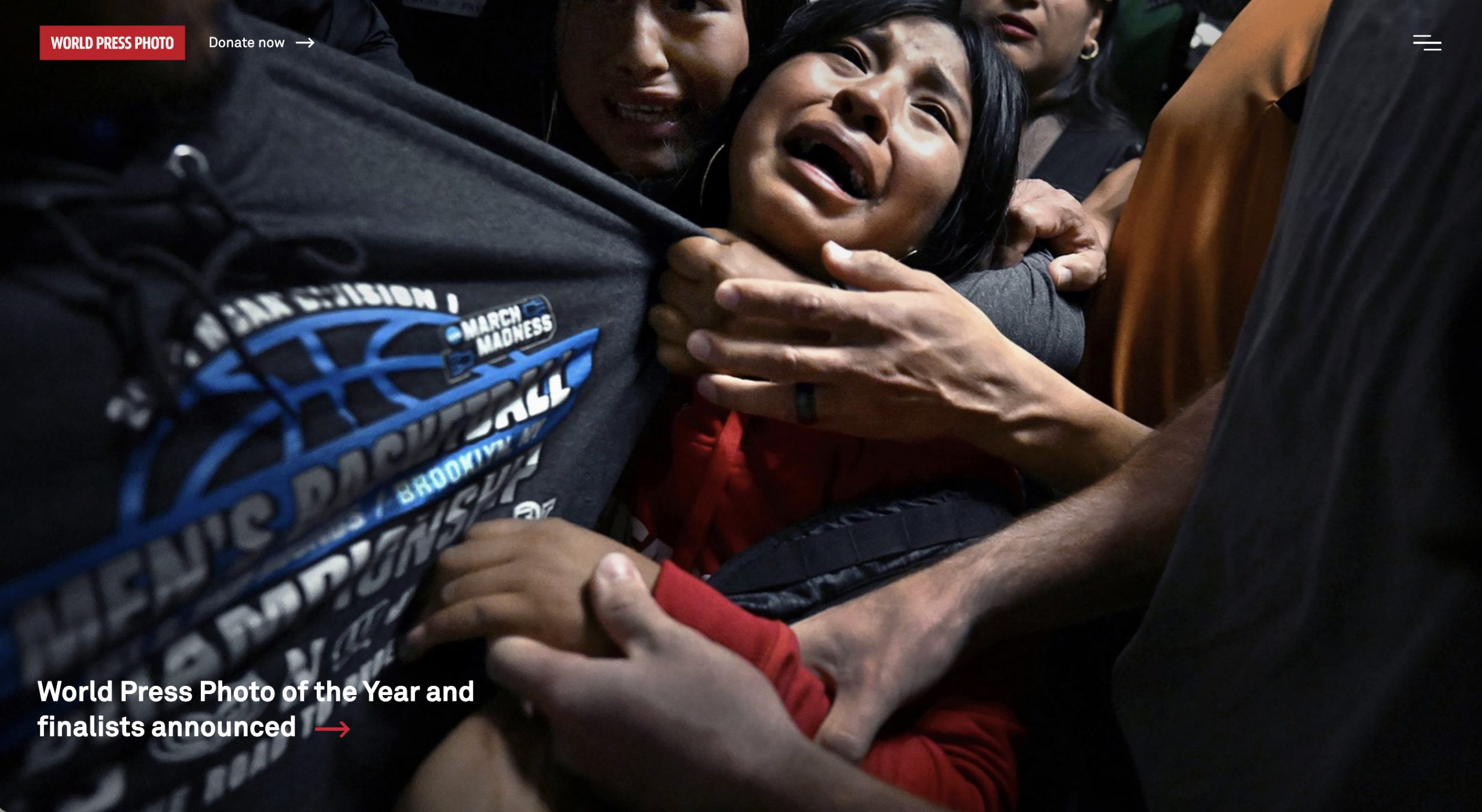
The 2026 World Press Photo of the Year, Carol Guzy’s image of an Ecuadorian father pulled from his family in an American courthouse during an ICE enforcement action, has been read as a vindication of photojournalism in the age of generative imagery. The two finalists carry similar weight. Saber Nuraldin, born in Gaza, has documented life there since 1997. Victor J. Blue spent fourteen years following the Achi women’s case in Guatemala until their abusers were convicted. Guzy herself spent five months entering the Jacob K. Javits Federal Building almost daily, on a long-term project she funded and sustained on her own. Read closely, these images are evidence of something the field is not willing to name: a survival strategy that is quietly destroying the thing photojournalism was supposed to be.
For most of the twentieth century, photojournalism was four functions fused into one professional identity. The photographer was a witness, present where things happened. They were an aesthete, composing the frame so it worked as a picture. They were a journalist, doing the deep informational research, the source-building, the deontological commitment to verifiable truth that the word journalism actually carries. And they were an emotional distiller, finding the single image that could compress an event into a feeling an audience could hold. These four functions were bundled because the technology and the economics required it: one person, one camera, one moment, one assignment, one printed page. The bundle is now coming apart, and each function is going somewhere different, or nowhere at all.
The reportage that disappeared
Photojournalism worked in two formats simultaneously. Newspapers and wire services ran single images, as they had since the 1880s. This was the native daily form, and it has not gone away. The single image had a clear justification: it covered breaking news, events that happened quickly, and offered no opportunity for multiple frames or moments of importance that were short-lived. Speed, brevity of the event, and deadline pressure. The form fit the function.
What disappeared was the second format that ran alongside it: the photo reportage, the four to five-page magazine spread with its own grammar. Life, Look, Vu, Picture Post, Paris Match, Stern, National Geographic, the Sunday magazines. The opening establishing frame, the detail shots, the portrait, the wide context, and the closing.
The photo magazine as a category started collapsing in the 1960s under pressure from television, decades before the internet. Look folded in 1971. Life ended its weekly run in 1972. The form survived in residual venues, such as the New York Times Magazine, National Geographic, and a handful of European titles, but the economics that supported sustained reportage were already eroding by the second half of the twentieth century. The internet finished what television started.
Strip away the sequence and what remains is the affective punch, severed from the reasoning that gave it weight.
What this took away was not the single image. The single image was always there. What it took away was the second venue where photographers could do extended work, alongside their daily output, with editorial structure to support it. A staff photographer at a major paper might shoot daily news for the wire and the front page, then be assigned to a multi-week story for the Sunday magazine or a national commission. The career held both. The bundle was not a single image versus a sequence. The bundle was wire-service work, magazine reportage, and staff infrastructure that supported both.
That bundle is gone. The single image survives as form, but its justification has migrated. Extracting a single frame from a fourteen-year project is not the same act as capturing a breaking news moment that lasted seconds. The form is identical. The reasoning behind it is not. The condensed image now stands in for work that the venue cannot accommodate, rather than for events that could not be photographed any other way. The single image becomes a compression of long labor, judged by criteria built for an entirely different kind of work.
The forced specialization
When the magazine collapses, the photographer can no longer be a generalist sent to the story. To get any work funded, they have to become the story’s permanent inhabitant, to specialize on a region, a community, a subject, often for decades. They have to own a beat the way a beat reporter owns city hall, except without the institutional support beat reporters used to have.
Hyperspecialization produces depth. It also produces dependency. The photographer becomes embedded to the point where they make connections, build relationships, owe access to the people they cover. They become friends with subjects, fixers, advocates. The journalistic distance, the deontological distance that lets you publish what the source wishes you wouldn’t, erodes. Subjectivity stops being a productive emotional transaction and becomes identification.
This is what photojournalism has lost. Journalism is not the same as documentation. The word carries a specific commitment: deep informational research, source verification, legal review, editorial independence, and the discipline to publish what the evidence supports rather than what the relationships allow. The institutional apparatus of the newsroom, the editor who could question the framing, the lawyer who reviewed the caption, the picture desk that controlled assignment, the budget that paid for the next story, so you did not need to keep returning to this one, was what made the journalism possible. American newsroom employment has fallen by more than half since 2008. Photo desks were among the first cuts. What remains underwrites individual photographers as personal brands rather than as members of an editorial structure.
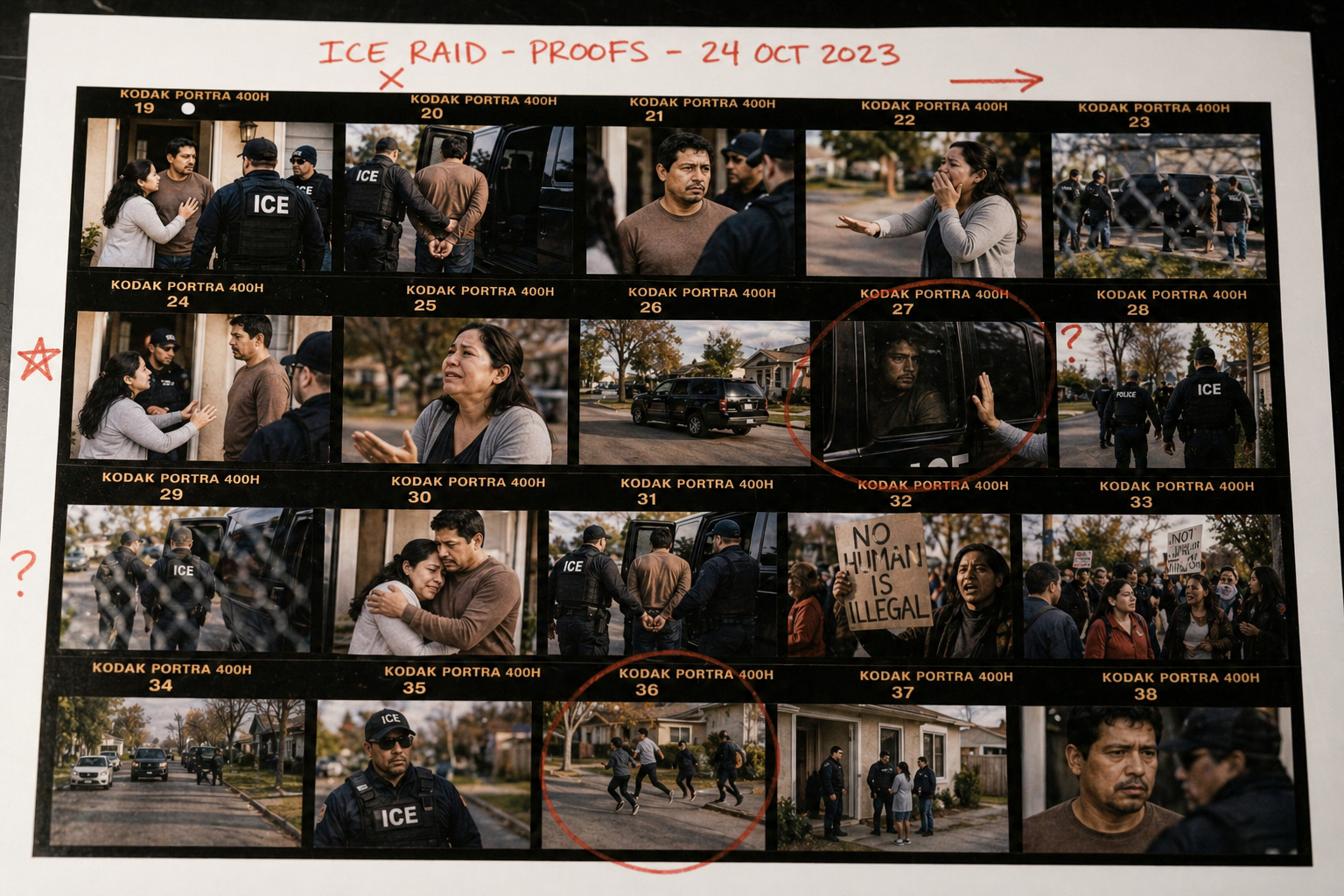
The freelance long-form photographer is now expected to be their own editor, their own legal review, their own ethical check, and their own funder. Almost no one can do all of these things while producing the work. The result is a field that looks like journalism from the outside but operates without journalism’s structural protections on the inside. The conditions for adversarial reporting do not exist. What gets produced is hybrid, sustained, careful, often empathetic, but no longer subject to the editorial constraints that made the work journalism rather than chronicle.
The career structure that used to rotate photographers across stories, assignments that moved you to a new continent every few months, and picture editors who broke up long engagements has been replaced by personal-brand specialization. The same photographers cover the same stories for years, not because they choose to, but because they cannot afford to start over.
Where the aesthetic went
The aesthetic function did not migrate to art photography or the gallery system, except for a handful of individual escapes. It moved to what is now called visual storytelling, the hybrid form that lives in NGO campaigns, foundation reports, brand journalism, explainer videos, and long-form sponsored features. Visual storytelling borrows photojournalism’s visual conventions but exists to convince rather than to inform. Accuracy is eroded by the need to convince. The aesthetic layer becomes superficial but necessary, dressing arguments rather than recording events. It’s closer to advertising than journalism. This is where many former photojournalists actually work now, often without saying so. The aesthetic standards survive there. The journalistic standards do not.
The contest as symptom
This is the frame that makes the 2026 winners legible as something other than triumph. Each photographer has done remarkable work. The structure that produced their work is the symptom. Three decades on a single territory is not a sign of a healthy profession. Fourteen years on a single case is not how generalist news photography operates. The Photo of the Year category itself was built for the breaking news single image, the moment that could not be photographed any other way, and now applies those criteria to long-form projects that compress years of labor into a single frame because no venue exists for anything longer. World Press Photo’s award structure cannot recognize this because it has no category for the loss it is documenting. The contest rewards the image. There is nothing left to award for the editorial structure that used to surround the image.
The field’s conversation about its future is mostly about images and tools, authentication standards, generative imagery, content credentials, and AI detection. The deeper crisis is structural. The medium that bundled photojournalism into a profession is gone. The strategy forced on photographers to survive that loss is producing work that increasingly cannot meet journalism’s deontological standards, even when it meets every other standard the field still recognizes. The 2026 winners did the work. The field that produced them is failing.
