
For most of the last forty years, the answer was simple. Design resided in a department. It had a door, a head count, a queue, and a budget line. Marketing wrote a brief, the design team produced the asset, and the asset came back through a review cycle that everyone, on some level, resented.
That department still exists in many organizations. But the work it once did has been quietly migrating elsewhere for at least a decade, first into marketing operations, then into individual contributors across sales, HR, and product, and most recently into the prompt box of a generative model. The question worth asking now is not whether design has been decentralized. That argument is over. The question is where the function actually lives today, and whether it will continue to exist as a recognizable role at all.
The three migrations
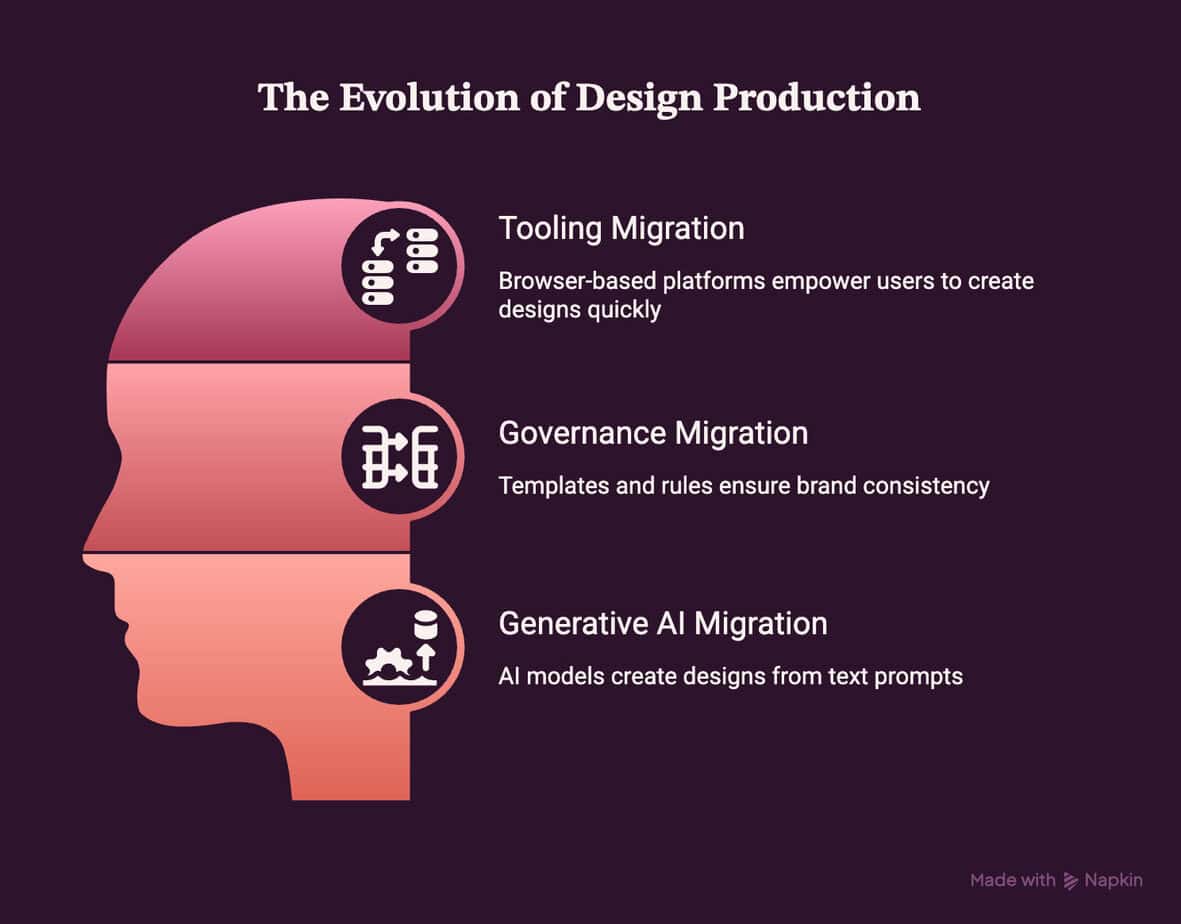
The first migration was tooling. Browser-based, template-driven platforms, Canva most visibly, Adobe Express alongside it, and Figma adjacent to it, made the production of acceptable-looking collateral a task that any literate adult with twenty minutes could complete. A regional sales lead no longer files a ticket for a one-pager. An HR coordinator does not wait three days for a benefits-enrollment graphic. The work happens at the desk where the need originated, and the design team is no longer the bottleneck because it is no longer in the loop.
The second migration was governance. Once the work left the department, someone still had to ensure that what came out the other side resembled the brand. The answer, broadly, was templates: a head designer or small brand team builds a library of locked layouts, defines the type system, sets the color tokens, and grants downstream users the ability to swap text, images, and a small set of permitted variables. The designer’s job shifts from producing assets to producing the rules that produce assets. This is the model most mature organizations operate today.
The third migration is the one currently underway, and it is the one that makes the future ambiguous. Generative models can now produce a passable banner, social tile, or pitch deck from a sentence. They can resize, reformat, restyle, and rewrite. They do not need a template in the traditional sense because they generate both the template and the asset in a single operation. If the second migration moved designers from execution to rule-making, the third raises the possibility that the rules themselves no longer need a human author.
Two futures, both live
There are two coherent readings of what happens next, and they point in opposite directions.
In the first reading, the design function continues to shrink. If a marketing manager can describe a campaign in natural language and receive a coherent set of cross-format assets, the head designer’s template library becomes redundant. The brand book becomes a prompt. The role compresses into a quality-control function, then thins further, then dissolves into the same fate that overtook in-house typesetters in the 1990s. The work does not disappear, but the job does.
In the second reading, the opposite happens. Generative models without constraints produce drift, not catastrophic drift, but the steady erosion of what makes a brand legible across thousands of touchpoints. The more powerful the generator, the more valuable the constraint layer that sits above it. Someone has to decide what the model is allowed to do, what it must never do, and how its output is measured against a standard. That work is not prompt engineering. It is a design system architecture, applied to a generative substrate rather than a static template library. In this reading, the head designer is elevated, not eliminated, moved from rule-writer to systems architect, responsible for the operating environment in which non-designers and machines both produce work.
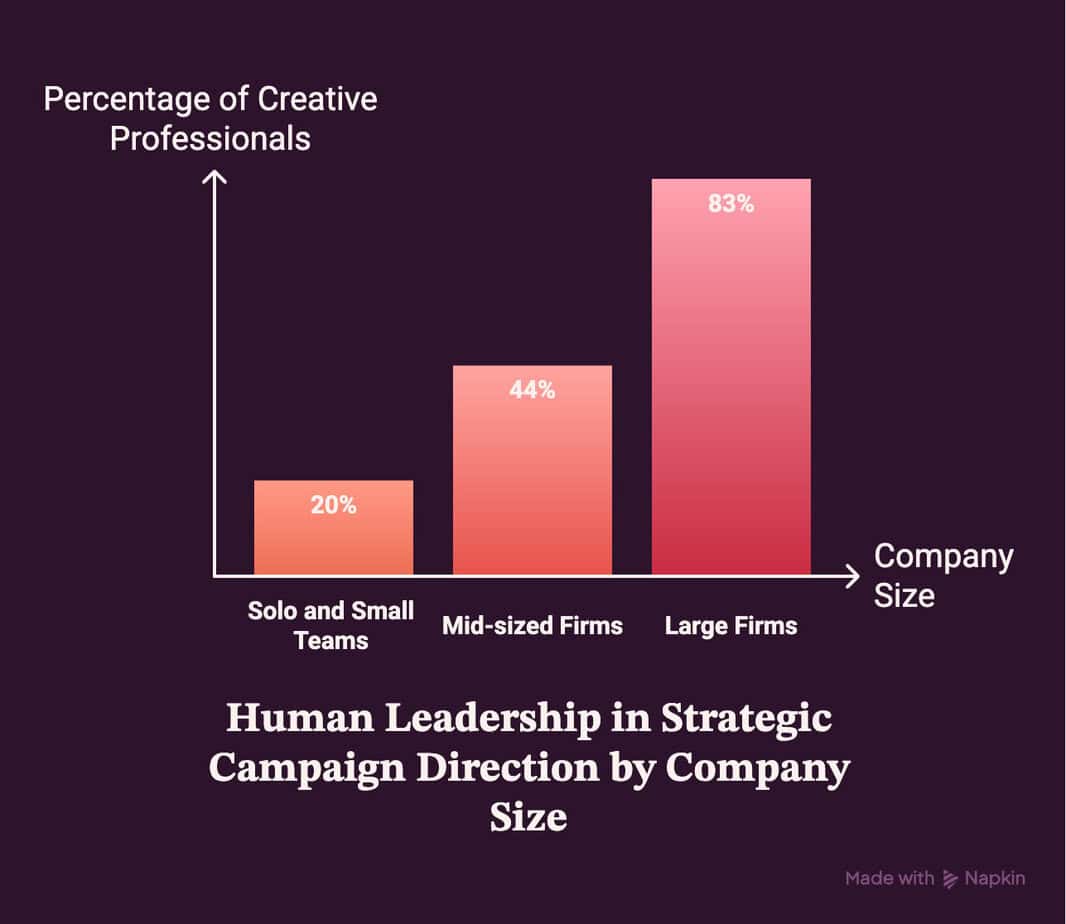
There is evidence that organizations already lean this way as they scale. In a 2026 Santa Cruz Software survey of more than 300 creative professionals, the share saying strategic campaign direction should remain human-led rose steadily with company size, from roughly a fifth of solo and small-team respondents, to 44% at mid-sized firms, to 83% at companies with more than 500 employees. The organizations running the most distributed production are also the ones most insistent that strategic judgment stay in human hands.
Both futures are visible in current procurement patterns. Organizations buying Canva at scale are betting on the first. Organizations investing in design systems, token libraries, and automation tools like Santa Cruz Software’s BannersUI — which lets a designer produce one source file and have the system derive a campaign’s worth of formatted outputs — are betting on the second. The distinction matters: a Canva-style tool democratizes production by lowering the floor; an automation tool of the BannersUI variety scales production by raising the ceiling on what a single designer’s output can cover. They look superficially similar and are not.
Decentralization without governance
Whichever future arrives, the intermediate state is messy. Decentralization without governance is brand-communication chaos, and most organizations are living in some version of it right now. The symptoms are familiar to anyone who has audited a mid-sized company’s outbound assets in the last three years: four versions of the logo in circulation, a typeface license that nobody can locate, social tiles produced in a free tier that strips metadata, a sales deck whose color palette drifted six months ago, and nobody noticed.
The cost of this drift is hard to measure, which is part of why it persists. Brand equity does not show up on a quarterly statement, and the marginal cost of one-off-brand assets is approximately zero. However, the cumulative cost of ten thousand of them is not, but by the time it registers, the damage is structural. The discipline that emerged to address this, Design Operations, or DesignOps, is the organizational response to a problem that the tools created and the tools alone cannot solve.
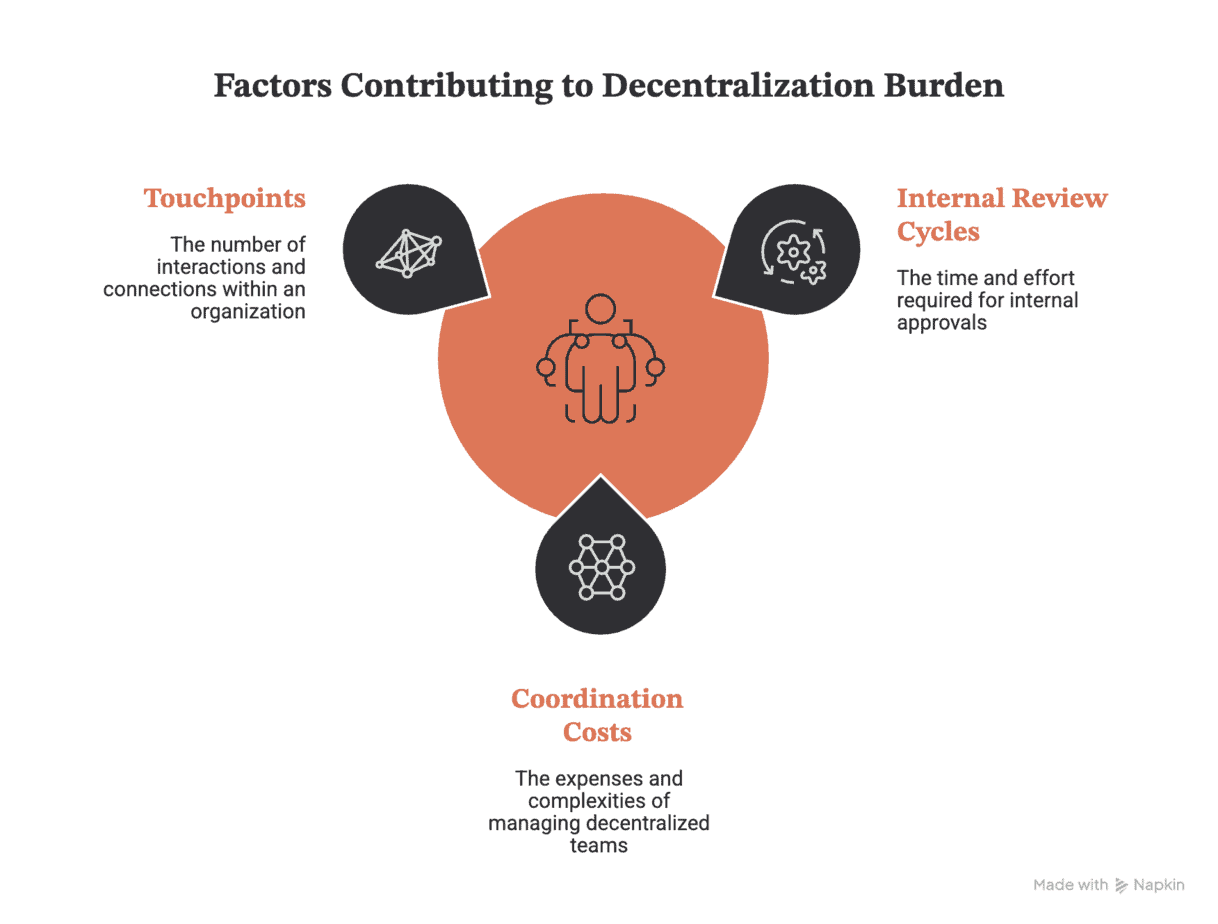
The burden of that governance falls unevenly. In the same survey, internal review and approval cycles were named a primary design bottleneck by 75% of respondents at companies over 500 employees, against only a small minority of solo practitioners — the coordination cost of decentralization concentrates in the organizations with the most touchpoints to hold consistent.
The DAM parallel
DesignOps in 2026 looks remarkably like Digital Asset Management in 2010. The same conditions are present: a proliferation of point tools, a governance problem nobody owns, a category name that means different things to different buyers, a vendor landscape dominated by startups making overlapping claims, and a slow recognition by enterprise procurement that the function is real and the budget needs to exist.
DAM followed a predictable arc. The early market was fragmented and confusing. A wave of consolidation followed: acquisitions, mergers, and the emergence of three or four platform vendors that absorbed the feature set of two dozen smaller ones. The category professionalized. Job titles standardized. Procurement got serious.
DesignOps is at the beginning of the same curve. The tooling is fragmented, the practitioners are mostly self-taught, and the buyers are still figuring out which budget line it falls under. The consolidation has not happened yet, but the conditions for it are in place: a recognized problem, a willing buyer, a fragmented vendor market, and a generation of practitioners who will demand integrated platforms once they tire of stitching together five subscriptions. The vendors that survive the consolidation will be the ones that solve the governance problem at the infrastructure layer, not the ones that ship the prettiest editor.
The bottom of the agency market
There is one more shift worth naming, because it is happening in plain sight and almost nobody is measuring it. The Canva–Figma–Express layer, taken together with the generative tools now embedded in each of them, is eating the bottom of the agency market.
The work that used to flow to small studios and freelance designers- the social tiles, the event collateral, the one-off landing page, the deck cleanup, the asset resize- increasingly does not flow at all. It is absorbed inside the client organization by a marketing coordinator with a Canva subscription, or generated directly by a model. The agencies that depended on this work as their entry-level revenue, training ground, and pipeline for larger engagements are watching the bottom tier of their funnel evaporate.
The industry surveys do not capture this clearly because they tend to measure billings at the top of the market, where strategy and brand engagements remain robust, and because the lost work at the bottom is distributed across thousands of small shops that simply close or pivot quietly. The aggregate effect is large. It is also irreversible: once a function is internalized at the cost of a SaaS seat, it does not flow back to external vendors when the seat renews.
What the role becomes
Returning to the original question: where does design reside now? The honest answer is that it resides in three places at once, in proportions that are still shifting. It resides in the templates and design systems built by a shrinking number of senior designers. It resides in the hands of non-designers across every department, mediated by tools that do most of the craft work for them. And it increasingly resides in the model, in the weights, the prompts, and the constraints layered on top.
Whether the senior-designer role survives the third migration depends on whether organizations view the constraint layer as critical infrastructure or as overhead. The technical case for the former is strong. The cultural case is weaker because the work of system architecture is invisible by design; when it functions correctly, nothing happens, which is precisely the outcome that procurement struggles to value.
The designers who will still have jobs in five years are the ones who can articulate what their constraint layer prevents, in language that a CFO recognizes. The ones who cannot will discover that the function they once performed has migrated somewhere they no longer have a seat.
This article was written as part of an ongoing series on AI and graphic design for Santa Cruz Software and first published on Design Week
Opening image : Photo by Hal Gatewood on Unsplash

Author: Paul Melcher
Paul Melcher is a highly influential and visionary leader in visual tech, with 20+ years of experience in licensing, tech innovation, and entrepreneurship. He is the Managing Director of MelcherSystem and has held executive roles at Corbis, Gamma Press, Stipple, and more. Melcher received a Digital Media Licensing Association Award and has been named among the “100 most influential individuals in American photography”
Comments are closed, but trackbacks and pingbacks are open.