
When a news image is modified via AI, everyone jumps in outrage, and it becomes an affair. If a picture of a (smiling) woman eating a fresh salad in her kitchen is AI-generated, no one really cares. In both cases, AI was used. Why is it that, in one case, it is unacceptable and, in the other, tolerated?
The reflex answer—”news is news, illustration is illustration”—collapses under the slightest pressure. The salad image will be seen by more people than most news photographs. It will shape what readers think a healthy meal looks like, what a kitchen looks like, what a woman who takes care of herself looks like. It carries cultural weight, just quietly. And when it turns out to have been synthesized by a machine, nobody writes a correction, asks where it came from, or seems to mind.
What we expect
The why sits in something we do every time we look at an image, usually without noticing. Before our eyes have finished reaching the frame, we have already asked the image to do something for us. We inject into an image expectations. Call it the precharge.
When we open a newspaper, we ask the image on the front page to deliver a fragment of reality we did not witness ourselves. Not art, not flattery, not entertainment. We rely on it to inform; we extend our trust that it will. The image is functioning as a stand-in for our own eyes. If it has been manipulated, that trust has been derailed, and the offense is real. Manipulation is the mechanism. The offense is the breach of the trust the image was carrying on our behalf.
The salad in the kitchen is doing nothing of the kind. The article is about Mediterranean diets, or aging well, or the joy of fresh ingredients. The image is decorating a paragraph. It is conveying an idea: health, satisfaction, the soft light of a Tuesday morning. It’s not a fact; it’s a concept. We ask it to be close enough and recognizable. We bring no demand for hard truth. Whether the woman exists, whether the kitchen is hers, whether the salad was eaten, whether she is really that happy, none of these questions arose for us before we saw teh image, and none of them arise after. The demand we placed on the image was soft, and the image met it. There is no betrayal to feel.

The context does the precharging. The same plate of eggs lands differently at a restaurant with 3 Michelin stars on its front door and at a roadside diner. Our expectations alter our perception. Images work the same way. A news site precharges the reader for truthfulness. A lifestyle blog precharges for mood. A retail page for accuracy of the object. A scientific journal for evidence. The image inherits the demand the room has already placed on it. The viewer walks into the contract without negotiating it. The image either meets the demand or it does not.
The hybrid image
This is the mechanism. Deception lives in the relationship between what we asked the image to deliver (the precharge) and what it actually delivered. The image is just one of the terms. The same image, in different contexts, can be honest or deceptive depending on the demand the viewer brought with them. A perfect AI-generated salad on a recipe blog is honest. The same image on a news site illustrating a story about food poisoning in a real city is a betrayal. Nothing changed in the file. Everything changed in the contract.
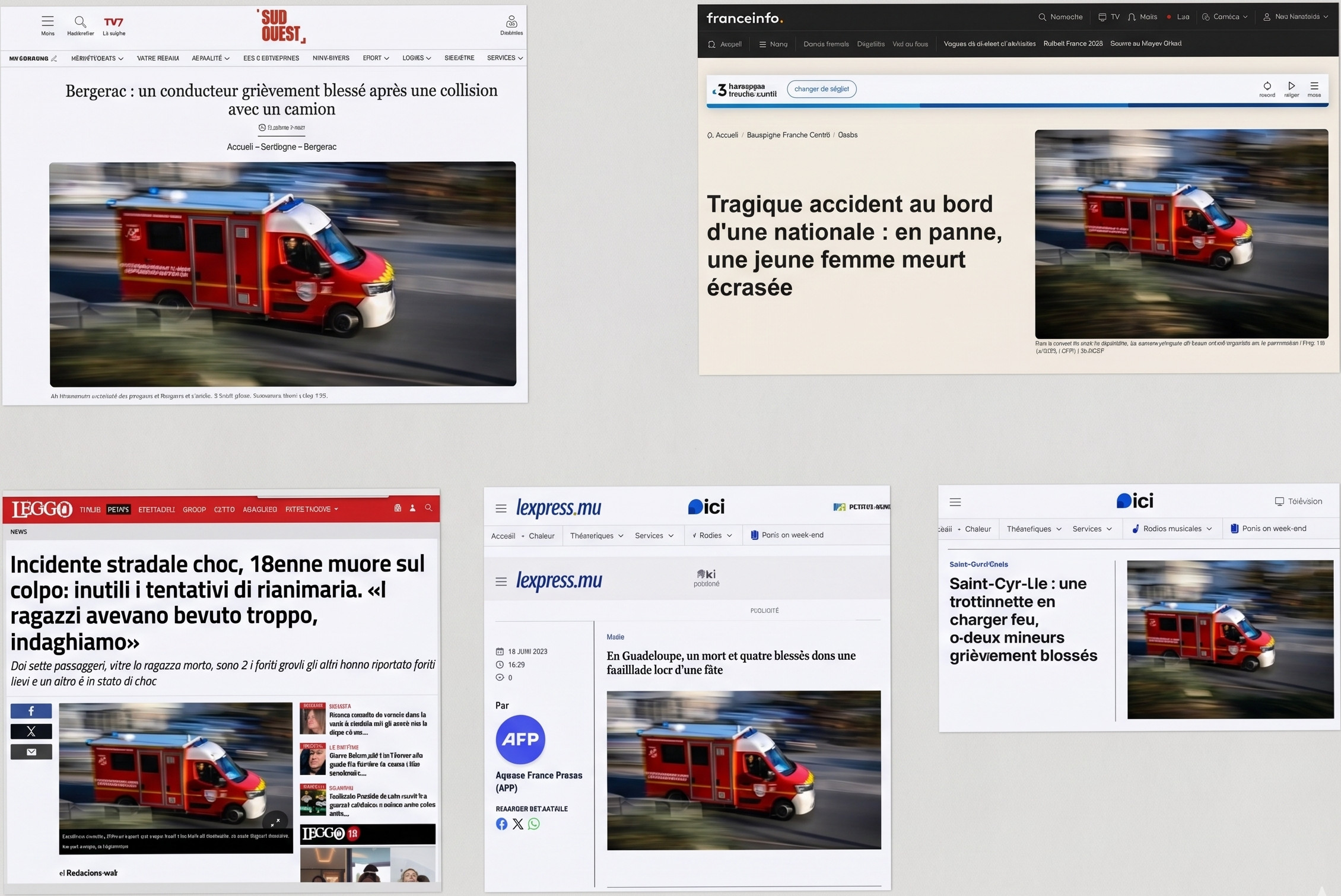
Once the mechanism is named, the middle of the spectrum opens up, and it is much larger than people admit. The actual middle is the hybrid image. The image that looks like news, travels with news, performs news work in the layout, but where the reader has never demanded that it be a witness to the specific event being reported. The stock photo of an ambulance illustrating a car accident. The stock photo of a courthouse exterior illustrating a trial. The stock photo of police tape used to illustrate a crime. The reader has always tacitly accepted that these images are generic stand-ins. Real ambulances, real courthouses, real police tape, just not this ambulance, this courthouse, this tape.
The image is doing informational work without making a documentary claim. The reader’s precharge is split. They want the image to look real enough to anchor the story, but they have given up on any expectation that the image was at the scene. They tolerated this for decades because the stand-in was at least a real photograph of a real instance of the category. It carried some residue of witness, even if not of the specific event.
AI breaks the residue. The AI-generated ambulance is no longer a real ambulance somewhere. It is no ambulance at all. The reader is not betrayed in the way the news image betrays them, because the reader never asked the image to document this event. But something quieter is happening. The class of images that occupies the informational middle is being severed from any tie to a witnessed reality. And the reader is being trained, every day, to accept images that look like documentation but never were.
What are we losing?
That training is the corrosion. The reader who has stopped expecting any tie to reality from the generic ambulance is the same reader who eventually looks at the aircraft carrier with a softer eye. Photography’s essential function, to be a trace of something that occurred, is being weakened from below, in exactly the layer of images where readers stopped paying attention.
What links all of these cases- the salad we tolerate, the news image we punish, the generic ambulance we never thought to question- is that the demand was never written down. For news, there are partial guardians: wire agencies, editorial codes, professional norms hammered out over a century. The contract is imperfect, but it exists. For everything else, the contract has always been tacit. The reader brought a demand, the publisher met it more or less, and a rough understanding was reached through repetition rather than declaration. Illustration could be staged because everyone tacitly agreed illustration could be staged. The generic ambulance could stand in for the real one because everyone tacitly agreed it could.
Who draws the line?
So the line moves by drift. Each new image accepted without question extends the territory of the tolerable. Each acceptance does work. It moves the line, image by image, in directions nobody has voted for. The line moves because we do not see it move. We are looking at individual images. The line is a property of the aggregate.
What erodes in this drift is photography itself. The medium has always carried, at its core, the implicit promise of witness — that whatever is in the frame stood in front of a lens, somewhere, at some moment. The aircraft carrier scandal is the symptom we notice. The generic ambulance is the disease. One enrages us because it broke a contract we knew we had. The other passes us by because we never wrote the contract down. The ambulance is what loosens our hold on photography’s documentary root, slowly, image by image, while we are looking elsewhere.
This is happening at the worst possible moment. Photography is being required to defend its essential function, to be a trace of something that occurred, at a time when the dominant new tool can produce photographic-style images of things that never occurred. The challenge is external and obvious. The corrosion is internal and quiet, and it is the deeper threat.
The line is in motion. The question is how much further we are willing to let it travel, while pretending we are not the ones moving it.
(This text was originally intended as a chapter for a book I am in the process of writing. It might still make it)

Author: Paul Melcher
Paul Melcher is a highly influential and visionary leader in visual tech, with 20+ years of experience in licensing, tech innovation, and entrepreneurship. He is the Managing Director of MelcherSystem and has held executive roles at Corbis, Gamma Press, Stipple, and more. Melcher received a Digital Media Licensing Association Award and has been named among the “100 most influential individuals in American photography”
Comments are closed, but trackbacks and pingbacks are open.