
Eleven years ago, I coined a term. I called them the photo generation.
The piece ran on Kaptur in April 2015, prompted by a Facebook study: 53% of US teens said Instagram helped define who they were, 63% used it to document their lives, and a third checked it before getting out of bed. My argument was that this was the first generation for whom photography was not a hobby but a native tongue. They were not learning to take pictures. They were constructing themselves through them. Identity, for this cohort, was largely photographic.
That argument held. What came next did not go the way anyone expected.
Defined by photography
Photography has always had a relationship with identity, but for previous generations, it was occasional. The photo generation made it continuous. The camera was always open, the audience always present, the image always one gesture away from being shared. They built their public selves in photographs, and those photographs accumulated into something resembling a life on record. Every moment worth living was also, almost automatically, a moment worth documenting.
This was new. Not just in scale but in function. Photography became the medium through which this generation understood who they were, tracked where they had been, and showed themselves to the world. They were born with a camera in their hands ( well, almost). It became the primary instrument of shared reality: the visual commons through which a generation made sense of itself collectively. What was true, what mattered, what was worth remembering, all of it, everything passed through the photograph.
The birth of photographic authenticity
What they also built, largely without noticing, was a precise and powerful visual literacy. Spending years making and consuming images at a volume no previous generation had approached, they developed something sharper than taste: the ability to read intention behind a photograph. They could feel the difference between a moment that happened and one assembled to look like one. The gap between authentic and performed became legible to them before it became legible to anyone else.

And they applied that literacy commercially. The stock photo of a woman smiling while eating a salad in a perfectly clean kitchen became cultural shorthand for visual dishonesty because this generation made it one. Brands that persisted with polished, staged imagery lost their attention. The entire visual grammar of marketing restructured itself around their instincts. Imperfection, grain, the slightly wrong angle, the unposed moment, the over-exposed flash: these became the signals of the genuine. They defined what authenticity looks like. They made it the standard.
Then someone fed it into a training dataset.
The broken mirror
Every signal the photo generation developed to mark a lived moment as real is now replicable by generative AI without a camera, without a moment, without anyone present. The imperfect framing, the candid energy, the quality of light at a specific hour, all of it absorbed and reproducible on demand. Mango’s 2024 campaign for its teen line used photorealistic AI images of girls in Marrakech that almost no one identified as synthetic. The aesthetic vocabulary the photo generation built to signal the real had become a production toolkit, and the industry is adopting it at scale.
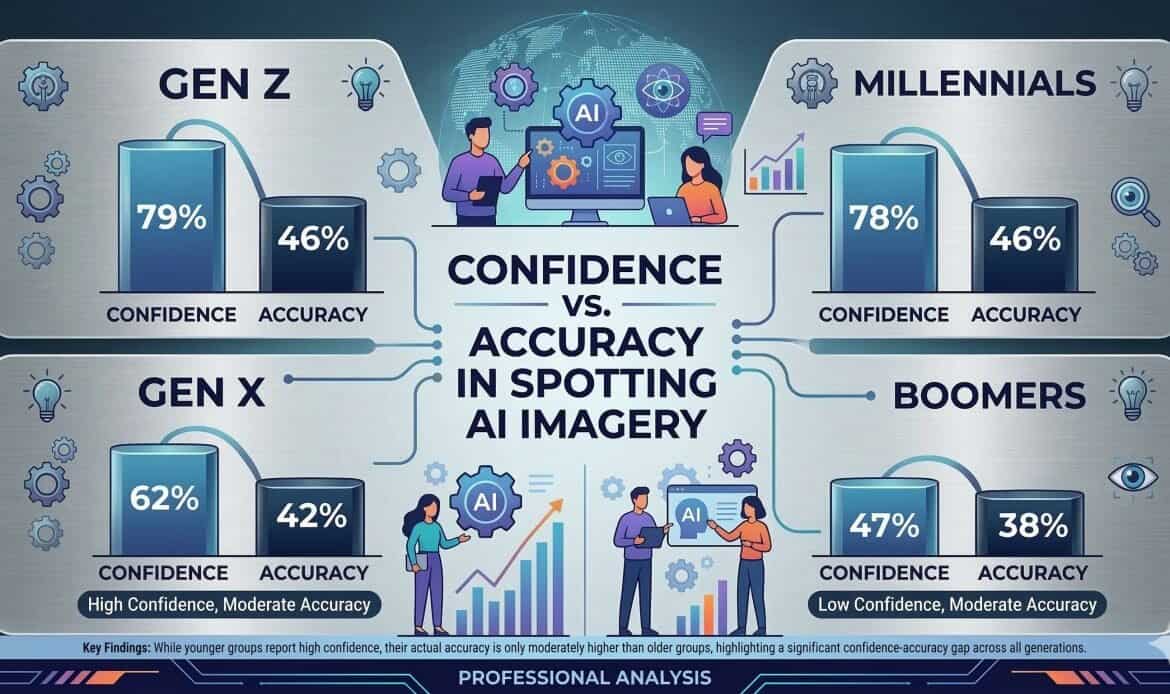
The irony is that Gen Z and millennials are the most confident in identifying AI imagery. When actually tested, they are tied for least accurate, at 46%, less than a coin flip. Their literacy was built for reading human choices behind an image. AI makes none. It has no intent to deceive or to be honest. It simply produces. And a skill built for reading human intention finds nothing to hold onto when there is no human intention present.
By means of deception
Deception, though, is still happening. It just lives somewhere else. Generative AI produces images with no origin in the world. The deception enters with the human choice to use that output and say nothing. The brand that runs an AI campaign without disclosure knows the image is a fabrication. The silence is the lie. And the intent is in that choice: the choice of the tool, and the choice to conceal it.
When the audience finds out, the damage is not confusion. It is humiliation. Trust is emotional, not rational. When you trust a brand, a photographer, a publication, you invest something of yourself. You lower your defenses. You let it inside the perimeter of what you believe. When that trust is broken by deliberate concealment, the injury is personal: you are made to feel foolish for having opened up. The humiliation is the core of it. And it is why we get the GUESS controversy, the quiet fury when readers discover an image they responded to was generated, none of it is really about the technology. It is about what was done with it, and what that says about how the audience was regarded.
The photo generation 2.0
The behavioral response has been a retreat to the perimeter of trust. If I can be visually lied to and cannot decipher it, I need to reduce my circle of trust to fundamentals. Grid posting among 16-to-24-year-olds is down 28% in two years. Close Friends Stories are up 42%. Direct messages now outpace the public feed. They are sharing images with people in their direct circle , people who were there , because when process cannot be verified externally, the known relationship becomes the verification. If anything can be faked, the only foundation that holds is the bond between the people sharing the image.
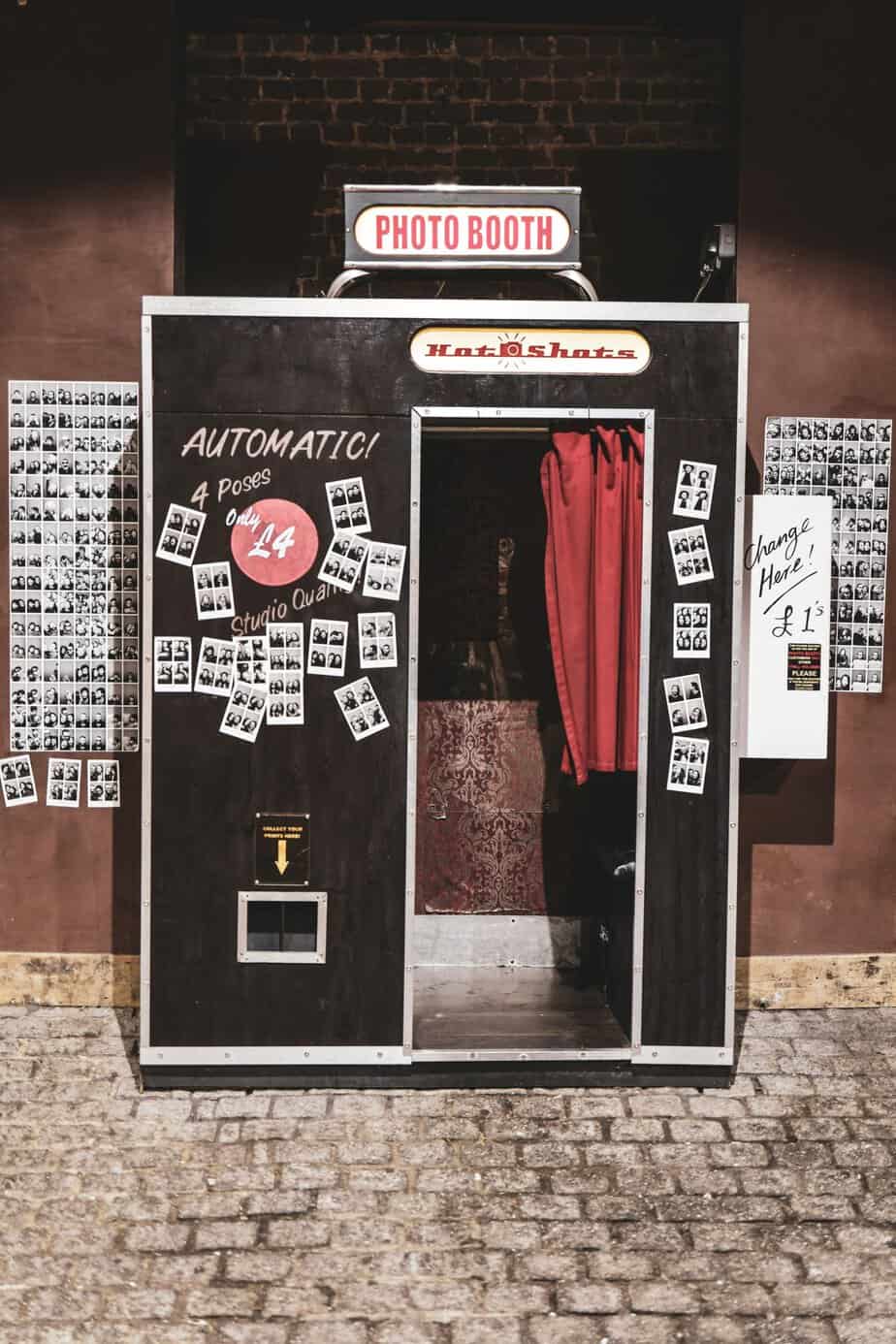
Teenagers who grew up after smartphones normalized instant photography are lining up to stand in a small enclosure and wait for a strip of images to emerge from a slot. The photo booth explosion is not a passing trend. These are not the younger siblings of the photo generation reaching for nostalgia. This is something different: the foundation of trust here is a shared physical, qualified moment, cemented by an analog capturing device you have to physically go to (instead of carrying with you). It is real because it was lived, together. Photography as proof of presence, which it has always been.
Film sales surged in 2024, with Kodak investing in additional capacity to meet demand, largely driven by the cohort born after film had already disappeared. Adults between 18 and 27 print photographs at twice the rate of older generations. The easy explanation is nostalgia. It is also the wrong one. Nobody prints AI images and puts them on their fridges. The print is not the point. The appeal is the act. You load a roll. You choose your frames carefully because you only have 24 (or 36). You imprint a reflection of light on a tangible surface. You surrender the image to a chemical process you cannot rush or review. You cannot delete what you didn’t mean to take. The photograph exists before you see it, which means something happened before the image was taken.
Photography’s relationship to time is not incidental. A photograph is literally a slice of time made physical.
Generative AI is the opposite of that. There is no moment. There is no duration. What the photo generation is doing with film is reinjecting time as a verification mechanism. They are taking photography where AI cannot follow. The time of capture: the shutter closed on a specific afternoon that cannot be reconstructed. The time of processing: the chemical wait that cannot be skipped or simulated. The time shared between people: standing together watching the strip emerge, holding it still wet, taping it to a wall. Not just taking the image together but viewing it together, in the same place, at the same moment. These are not aesthetic choices. They are temporal ones. Time is being reclaimed as proof because time is the one thing AI image generation structurally cannot provide.
The question at the end
The question that sits at the end of all this is uncomfortable. The photo generation built photography into the primary shared visual language of an era. They made it the instrument of identity, collective memory, and common reality for hundreds of millions of people. They defined photography as much as photography defined them. What happens to that language when its signals have been industrialized, when the images it produces can no longer be presumed to have originated in the world, when the only reliable trust is the kind that comes from knowing who sent you the picture and being certain they were there?
Whether photography survives that contraction as a shared instrument of truth is a question the photo generation did not expect to be answering. They are the ones who built what is being taken apart. They are also, for exactly that reason, the ones who understand most precisely what has been lost. And apparently, their younger siblings are the ones providing a glimpse of the answer.
