
Walk into a camera store today and notice what’s actually on the shelves. A Leica Q3 next to an iPhone 17 Pro next to a Matterport Pro3 next to an Insta360 next to a Fujifilm Instax. These aren’t variations of the same product. They aren’t competing for the same buyer. They aren’t even making the same kind of object.
For most of photography’s history, the instrument was a constant. Format changed, sensors replaced film, autofocus replaced rangefinders, but the device in the photographer’s hand was recognizably the same device, doing recognizably the same thing: framing a moment, capturing the light, producing a flat image meant to be looked at. The camera was a means. The image was the point.
That arrangement has quietly come apart. The instrument is no longer a means to a shared kind of image. It’s the first and largest creative decision a photographer makes, and everything downstream, tone, narrative, audience, authority, flows from it. The camera bag has become a set of voices. Picking one up is picking which voice will speak.
Each specialized instrument now adds a further authority, a further claim about reality that the baseline alone doesn’t provide. The fragmentation isn’t in the foundation. It’s in the additions. And the additions have hardened into separate photographies, each with its own community, its own workflow, its own jurisdiction.
The DSLR and its mirrorless heirs
Start with the tribe that refuses to add anything. The DSLR community, and now the mirrorless full-frame community that inherited it, has built its identity around the baseline alone. The Leica Q3, the Sony A7, the Fujifilm X-T5 are instruments designed to record what the lens sees and then get out of the way. Post-capture processing is acceptable because it happens in the open, after the file leaves the camera. The RAW file, fully malleable but transparently so, is the working document of the tradition. The authority this confers is the purity of the baseline itself, and the refusal to add anything is the contract.
The smartphone
The phone in everyone’s pocket adds computational interpretation. The image that appears on the screen is optical fact and co-presence plus a layer of algorithmic decision-making about what the scene should have looked like — exposure balanced, faces sharpened, skies deepened, noise removed before the photographer ever sees the file. The authority is over a kind of consensus-pleasant rendering of the moment. Billions of images a day are made under this contract. Most viewers no longer notice the layer is there, which is precisely the point.
Instant and analog
Instax, Polaroid, the resurgent 35mm rolls in Gen Z hands. These instruments add three things at once. The image is made to be shared in the same room at the same time, passed hand to hand while the moment is still warm, a contract of presence that digital sharing, with its distance and delay, cannot offer. No algorithm has touched the image; no AI, no computational layer, no silent decision made by software about what the scene should look like. And the chemistry forecloses revision. What came out of the camera is the photograph, with no RAW file to grade, no slider to nudge, no second chance. Where the DSLR tribe accepts post-capture work as part of the craft, the analog tribe refuses even that. The grain is evidentiary.
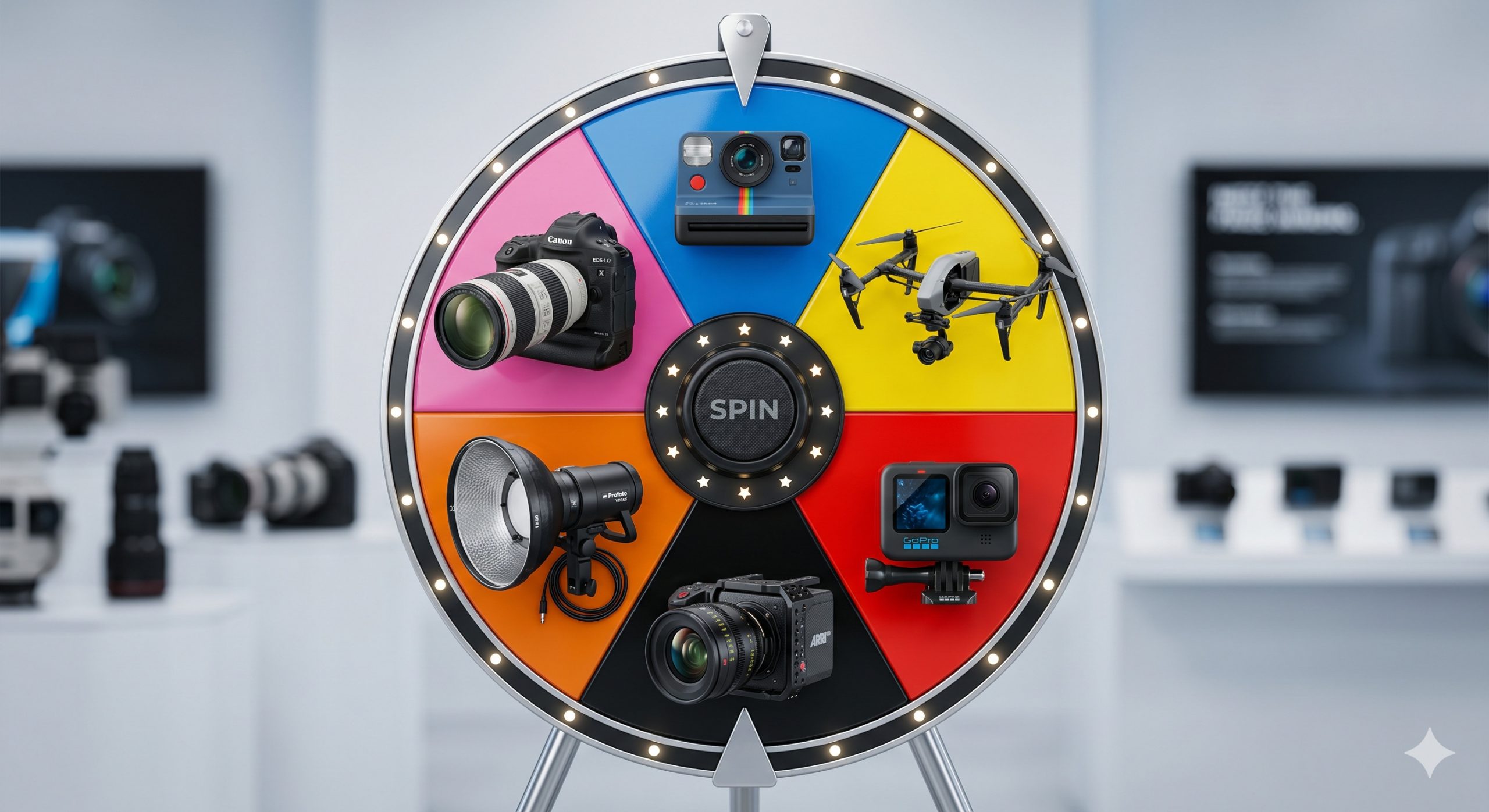
Action and 360
GoPro, Insta360, the helmet, and handlebar cameras. These add embodied perspective. The photographer’s body is part of what’s being recorded; the image claims first-person physical engagement with an event rather than its observation. The authority is phenomenological; this is what it was like to be inside the moment, not outside looking in.
Drone
The aerial camera adds vantage humans don’t naturally occupy. The authority is access to a viewpoint that until recently required a helicopter or a cliff. The image carries a particular kind of credibility precisely because it shows what the unaided eye cannot reach.
Matterport and the navigable cameras
The real estate scanner and its cousins add spatial navigability. The output isn’t an image meant to be looked at; it’s a space meant to be moved through. The authority is geometric coherence; does the captured environment hold together when the viewer walks across it? Whether any single frame inside it ever existed as a photograph in the older sense becomes secondary. Photography here has stopped being about moments and started being about volumes.
The instrument is the message
Set these instruments next to each other, and a pattern emerges that goes beyond format or workflow. Knowing which camera made an image tells you most of what the image is going to say before you ever look at it. The subject matter, the framing, the tone, the audience, the use, all of it is largely pre-determined by the instrument the photographer reached for.
The creative act of choosing what to photograph has been preceded by a larger creative act: choosing what kind of photograph to make. That choice is made when the camera is selected, not when the shutter is pressed. Creative photographers use this against itself, picking the wrong camera on purpose, a drone for a fashion shoot, a Matterport for a portrait, and borrowing a visual vocabulary the image was initially never meant to carry.
For roughly 180 years, photography operated under a single truth-contract contested, debated, but coherent. The image was a trace of something that had been in front of a lens. Arguments about manipulation, staging, and darkroom work all took place inside that shared frame. The frame itself was not in question.
What’s happening now is different. The frame is splintering. Each instrument is settling into its own answer to what the image is claiming, and those answers are no longer commensurable. A Matterport scan and a Leica frame are not competing definitions of photography. They are different photographies, accountable to different criteria, addressed to different viewers. The DSLR tribe’s purity, the analog tribe’s chemistry, the action camera’s embodiment, the drone’s vantage, the navigable scanner’s geometry, each carries its own contract with reality, and none of them can be judged by the others’ standards.
Photography hasn’t fragmented into formats. It has fragmented into epistemologies. The camera the photographer picks up is no longer just a tool. It’s a choice of what kind of truth the resulting image is going to be held to.

Author: Paul Melcher
Paul Melcher is a highly influential and visionary leader in visual tech, with 20+ years of experience in licensing, tech innovation, and entrepreneurship. He is the Managing Director of MelcherSystem and has held executive roles at Corbis, Gamma Press, Stipple, and more. Melcher received a Digital Media Licensing Association Award and has been named among the “100 most influential individuals in American photography”