
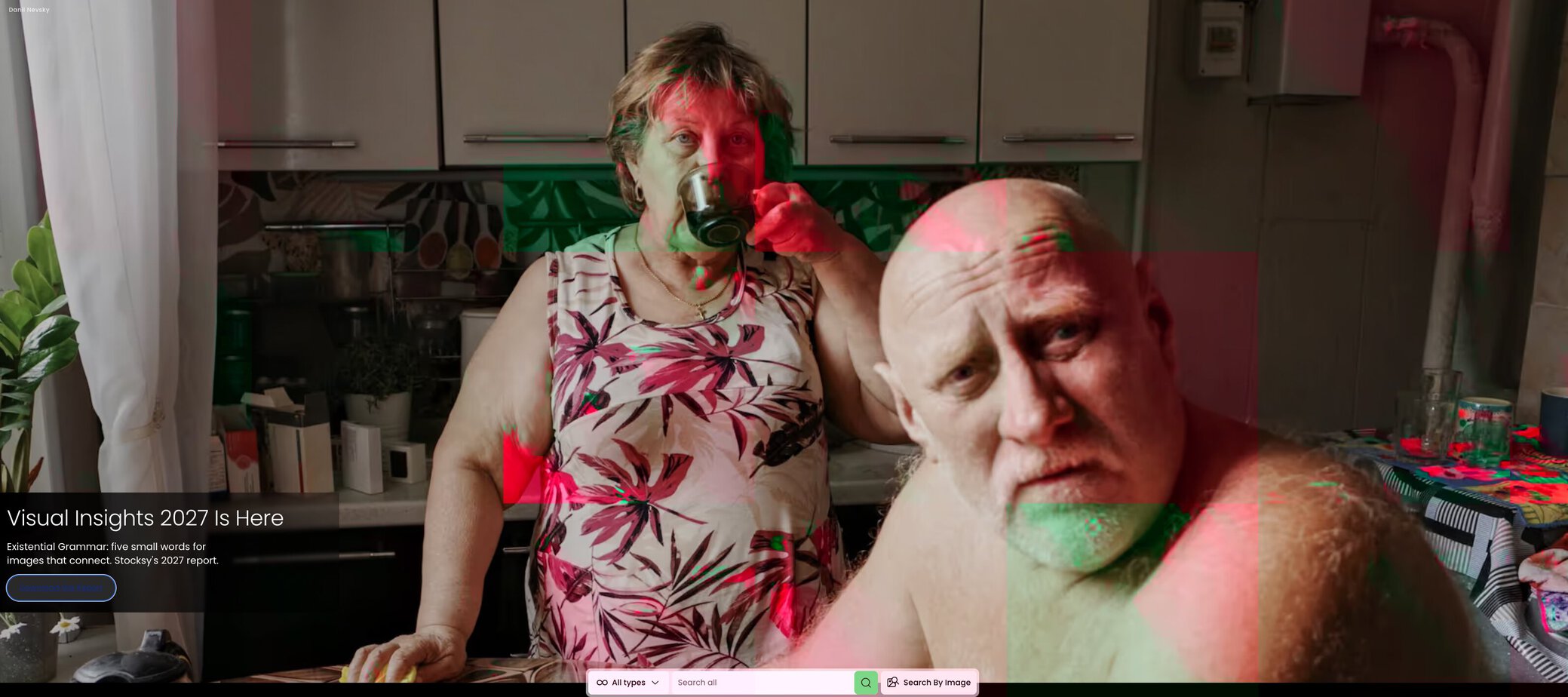
Two reports came out recently, both asking how commercial images will earn trust in 2027, now that AI can produce any image a brief calls for. One comes from Pixelz, a company that sells e-commerce post-production and, increasingly, AI-generated visuals. Its E-commerce Visual Trend Report combines an audit of 200 product pages from 100 brands and retailers, a survey of 32 industry professionals, a survey of 250 UK and US shoppers, and a series of LinkedIn polls. The other comes from Stocksy, the artist-owned stock agency, under the title Existential Grammar: Visual Insights 2027. It contains no data at all. It is an essay, illustrated with images from Stocksy’s own collection.
They converge on the problem and diverge on the cure. For Pixelz, what broke is the human look: “Looking human no longer proves anything.” For Stocksy, it is plain representation. A product on a white background or a couple walking on a beach at sunset no longer says enough by itself. “Representation is no longer enough.”
Chasing the signal
Pixelz starts from what shoppers told it. 53.4% say authentic content would increase their trust in a brand, and overuse of retouching is the top reason their trust decreases. On the brands’ side, consumer trust (54.2%) and product accuracy (41.7%) are the two main brakes on AI use. Both, Pixelz notes, “concern whether the image accurately reflects the product a shopper will actually receive.”


Pixelz’s first trend, “Authenticity moves again,” opens with a confession. The markers of “real” Pixelz promoted in past reports, film grain, light leaks, and slightly imperfect composition, are now applied by AI generators “for exactly the same reason, to add that human element.” Stocksy went through the same cycle. Its 2026 report, Signs of Life, called flaws “the sticky fingerprints of human authorship,” with grain, glare and uneven lighting as “the subtle trace of a hand.” One year later, both companies have dropped those markers. AI caught up (perhaps it reads trend reports too).
So Pixelz proposes new markers: messier styling, looseness over polish, behind-the-scenes content, a strong point of view. Its examples are Aerie, which refuses both retouching and AI, and the loose, slightly messy Celine x Reebok packshots. The brands reading as authentic in 2027, it predicts, will show “evidence of hands,” with slightly messier styling, “but still with that perfect retouching.” The one practice shoppers name as their first reason to distrust a brand stays in the recipe. (Pixelz sells retouching.)
Then there is the test. Pixelz showed shoppers four images, three AI-generated and one real, and asked them to find the AI ones. 57.8% had said they were confident they could spot an AI image. 48.3% picked the real photograph as AI. Almost one in two.
This is why the signal approach cannot hold. A brand applies a marker to an image to make it read as human. A generator can apply the same marker, for the same reason, and the cycle starts again. Messy styling will follow film grain. Pixelz ends up defining authenticity as “whether the output feels trustworthy and true to the product.” Feels. The shopper’s feeling is the one instrument its own survey shows to be unreliable. In short, authenticity sits in the consumer’s eye, not in the image itself. Hold that thought.
Two kinds of labels
Pixelz’s other answer is the label. 71.7% of shoppers want brands to disclose when any part of a product image is AI-generated, and a lonely 6.2% think no disclosure is needed.
There are two kinds of labels, and they do very different work. The first is a statement the seller attaches to its own image. Its value depends entirely on trusting the seller, whose credibility is the very thing the image was supposed to establish. The second is a credential signed at capture and carried with the file, visible or machine-readable, that anyone can check without taking the brand’s word for it. Professional cameras from Leica, Sony and Canon already do this. Only the second kind survives an audit, because it is the only one a generator cannot copy into the picture.
Product photography also has a backstop the trend reports leave out. The box arrives, and the image is either confirmed or proven wrong. If it is wrong, false-advertising rules and painful return rules already apply, regardless of what tool made the picture. The accuracy question that worries Pixelz’s professionals has an answer at the door and another one in the law.
A grammar for meaning
Stocksy takes a third road: visual language. Its report never uses the word “authenticity” in its own voice. The word appears twice in 38 pages, once in the name of an Apple feature and once in the title of a footnoted article. “Trust” appears once.
What it offers instead is a grammar. Stock search, the report explains, organizes images by nouns, by what is in the frame: a family, an office, a woman laughing. That gives buyers something to recognize, but “recognition is not yet intimacy.” For Stocksy, meaning sits in the relationships an image sets up, and it names them with five prepositions: by, for, with, between and against.
The approach fits how stock photography sells. A stock image rarely, if ever, shows the product it helps sell, so no box arrives to confirm or contradict it. Whatever trust it earns has to come from what the image says and from the relationship it builds with the viewer.
Two of the five prepositions deal directly with trust. “By” treats authorship as a supply chain: whose perspective, whose labor and access, what technology entered the process, and “who is visible in the credit, and who disappeared?” Stocksy compares it to farm-to-table coffee and chicken, where disclosing origin became “both an ethical demand and a mark of quality.” It also points to the Hermès bag made by a single artisan, whose stamp is “the reason the bag costs what it costs.” It cites the Leica M11-P and Apple’s Reference Image, launched with the iPhone 18 Pro, and concludes: “Who a picture is by is already visible in the picture. Provenance just makes it legible.” This is the second kind of label, arrived at from the opposite direction.
“For” asks who is on the other side. Stocksy quotes Roland Barthes, for whom a text finds its unity “not in its origin, but in its destination,” with the reader as one of meaning’s makers.
Back to that thought from above. Pixelz also places authenticity in the eye of the beholder, but there the eye serves as a judge of whether the image is true, a job it fails at half the time. Barthes gives the beholder a different job: completing what the image means. Its test for 2027 is “whether anyone was meaningfully imagined on the other side,” whoever or whatever made the work.
The irony
Stocksy’s text warns against reducing authorship “to a claim of purity with a human-made sticker attached.” Its back page reads, in capital letters, “100% HUMAN MADE.” When it comes to selling its own collection, Stocksy reaches for the first kind of label, the one its own essay dismisses.
A better lie?
Put side by side, the two reports describe a moving target. Every visual marker the industry picks to anchor authenticity, AI learns to reproduce, usually within a year. What survives is the signed credential, attached to the file and checkable by anyone. Everything drawn into the picture itself will be copied.
That raises the question neither report asks. The bar for authenticity in advertising has always been low. A stock image of a family at breakfast was staged long before any generator existed: paid models, a rented kitchen, a moment that never happened. Product photos are already held to the box and to the law. So what are we really trying to protect when we ask a commercial image to look authentic? A better lie?

Author: Paul Melcher
Paul Melcher is a highly influential and visionary leader in visual tech, with 20+ years of experience in licensing, tech innovation, and entrepreneurship. He is the Managing Director of MelcherSystem and has held executive roles at Corbis, Gamma Press, Stipple, and more. Melcher received a Digital Media Licensing Association Award and has been named among the “100 most influential individuals in American photography”
Comments are closed, but trackbacks and pingbacks are open.