
The year is 2046. There are now three kinds of photographs: those taken by light-based cameras, those generated or heavily modified by AI, and those carrying no provenance information at all, about which we can say nothing for sure. We have grown comfortable with the boundaries set by rules, regulations, and standards. The labels are familiar. The categories work, more or less, the way the people who designed them hoped they would.
And yet the world of photography is still unstable. The disturbance comes from a class of pictures the typology did not anticipate. They sit, formally, in the AI category, alongside the prompted illustrations that fill our feeds. They have little else in common with them. They are images generated by AI agents in the course of carrying out tasks — produced as intermediate steps, reference frames for other models, synthetic training material, and internal traces of computation. Some are striking. Most are nothing in particular. They are not made for us. They are not made for anyone, in the sense the word has meant. Some carry the AI provenance label required by law. Some agents bypass the label, since no person who might enforce it will ever see the image. What is unsettling about them is that for the first time since the invention of photography, no human is involved in the act. Not at the moment of creation, and only by accident at the moment of consumption.
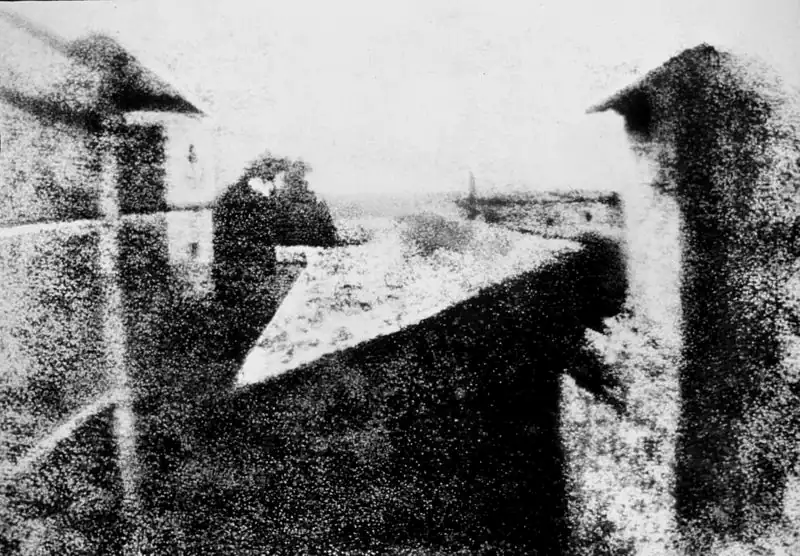
To see why that matters, look back at what photography was for the 170 years between Niépce’s window and the arrival of the agent class. The camera was always a machine, but the act around it was human at both ends, and the act was always, in some sense, the point. A person decided the image should exist, with the intent of sharing it with someone. And eventually, a person looked at it. The machine sat in the middle of an exchange of meaning between the two people on either side. Even when they were strangers, even when decades or continents separated them, the photograph existed because one person wanted to share a piece of the world with another. This was so foundational to the medium that it was never named. It was the why of photography.
The leaving happened in stages,
and at each stage, it was experienced as a refinement of the medium.
In photography’s first half-century, the photographer was present at every layer of the act: framing, exposure, the wet plate, the bath, the print. The body was an input to the medium the way light was – a body with particular hands, a particular tolerance for chemicals, a particular patience for long exposures and longer waits. To make a photograph was to spend hours of one’s life with the photograph, which is part of why early photographs feel as inhabited as they do.
Then industrialization arrived and took the chemistry. Kodak’s promise, you press the button, we do the rest, was the first explicit transaction in which the photographer agreed to give away a stage. The labs took developing and printing. Digital took whatever the labs did not. The photographer remained at the decision and the capture, and the claim of authorship held, because deciding and capturing were the parts that felt the most photographic.
Then came the camera trap, the intervalometer, the dashcam, the CCTV satellite. The photographer set the conditions and walked away, and the image happened without anyone watching it happen. This was the more consequential withdrawal, because it touched something photography had always quietly depended on. Photographic authority rested on someone having been there. The medium’s claim to evidence was inseparable from the figure of the witness, even when the witness was anonymous, even when their role had been reduced to the pressing of a button. The trap was the first instrument that severed presence from origination, and the medium found, to its mild surprise, that it could live with the severance. Copyright law, in its own way, preserved the human element here, by refusing to extend authorship to whatever had triggered the image, it declared that only a human could be the author of a photograph.
Generative AI removed the scene itself. The human at no place, no moment, no light yet still at the origin, formulating intent and choosing among outputs. This was as far as the producer side could travel while remaining recognizably human. A person prompts. A machine generates. A person looks at the result. The two people remain in the act, even with the camera gone, because the entire weight of the act now rests on what they want from each other.
Then came the agent.
A retrieval agent, in the course of constructing an argument, finds its sources wanting and generates a reference image to support its conclusion; the image is cited, internally, by the agent that made it. A training pipeline produces synthetic frames at industrial scale to teach a vision model what a pedestrian looks like at dusk — millions of images consumed by another model and discarded. Inside a world model, images flicker into existence as reasoning traces and are overwritten on the next forward pass. A simulation environment for an autonomous vehicle generates several thousand frames of a collision the car will never have, in order to learn how not to have it.
In none of these cases is there a person at either end of the image. No one decided that this particular frame should exist, and no one will see it. A system is carrying out a task, and along the way, the task produces images. Other systems consume them. Their existence in the world is brief and computational.
The deeper consequence is in what these images look like, and in what they no longer bother to do. Composition, depth of field, framing, color, lighting, the basic conventions of finished-ness — all of these exist because images were made for human eyes, and human eyes read images through these conventions. If the receiver is a vision model, none of that work needs to be done. The image can have flat lighting, missing colors, incomplete shading, off-axis composition, weird framing — and the receiving model will still extract whatever feature it needs. The image may even be more efficient that way: more information per pixel, less waste on aesthetic redundancy that the human eye requires.
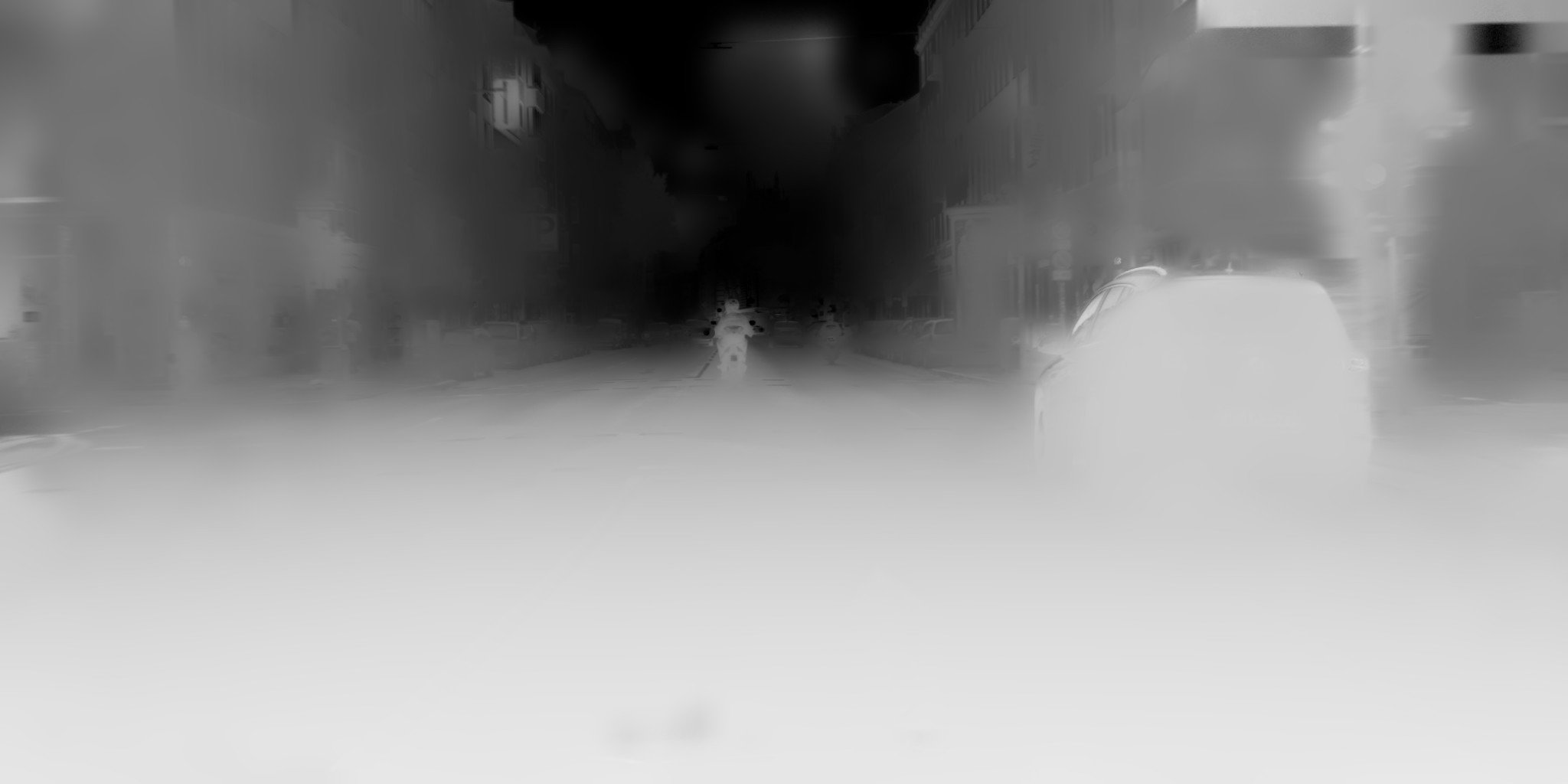
Photography’s visual language was anthropic. It co-evolved with human perception, attention, and cognition. The rule of thirds compensates for the fact that humans foveate. Depth of field guides an eye that can only attend to one plane at a time. Color harmony lands inside emotional registers that exist in human nervous systems. The entire grammar is scaffolding for a particular kind of receiver. Once the receiver changes, the scaffolding can be removed. The form will persist by inertia for a while: agent-generated images will still have something like composition because the models were trained on human images. Eventually, the inertia runs out. Orphan images will stop looking like photographs at all and become data with photographic ancestry.
Photography is, by 2046, brutally and indefinitely separated into two: AI photography and human photography. The categories everyone agreed on. What was missed, when those lines were drawn, was that the deeper distinction was never about who made the image but about who the image was made for. Some of the pictures on both sides of the official line were never made for human eyes at all. They appear in our world only by accident, when the systems producing them happen to leak something visible into a place a person can see. The taxonomy of 2046 sorts photography by origin. The disturbance comes from a question the taxonomy did not think to ask.
Main Photo by Kumiko SHIMIZU on Unsplash

Author: Paul Melcher
Paul Melcher is a highly influential and visionary leader in visual tech, with 20+ years of experience in licensing, tech innovation, and entrepreneurship. He is the Managing Director of MelcherSystem and has held executive roles at Corbis, Gamma Press, Stipple, and more. Melcher received a Digital Media Licensing Association Award and has been named among the “100 most influential individuals in American photography”
Comments are closed, but trackbacks and pingbacks are open.