
For most of photography’s history, a photograph was its own proof: if you had a picture of something, it had probably happened. AI has ended that, producing images the eye cannot tell from real photographs, which is an acute problem for anyone whose work depends on a photograph being believed.
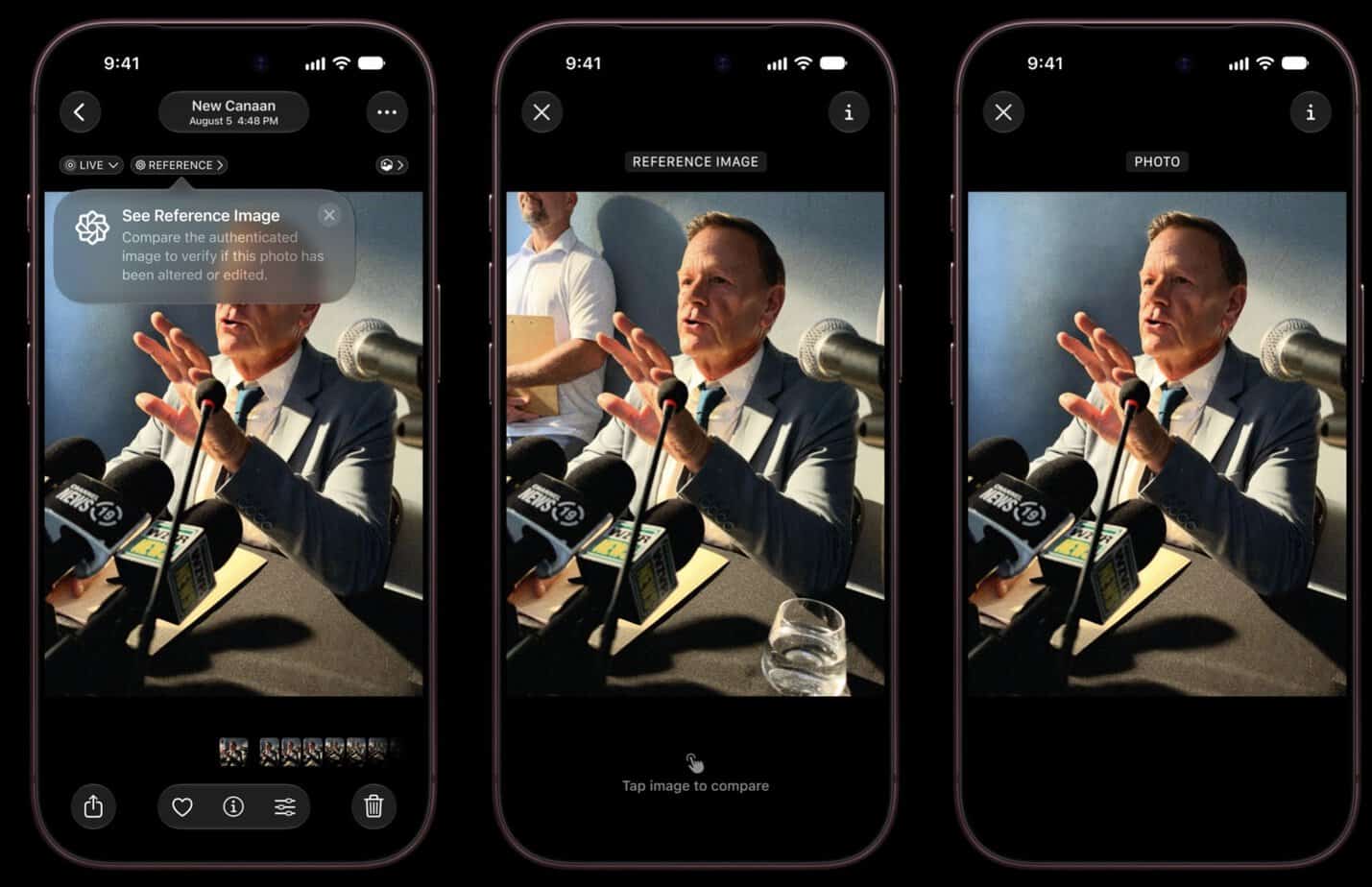
Apple’s answer, announced on September 9 with the iPhone 18 Pro, is a feature called Apple Reference Image. It is optional, and it works only when you deliberately turn it on. You switch the camera into a new Reference mode, and then you shoot as usual.
Here is what happens when you do. At the moment you press the shutter, the camera’s main sensor cryptographically signs the image it captures, meaning it attaches a kind of tamper-proof seal to the picture data as it comes off the sensor. That signed data is sent to Apple’s secure cloud servers, which use it to produce a second, locked version of the photo. Apple calls this the reference image and compares it to a digital negative: a fixed record of what the camera saw, one that cannot be altered afterward.
You end up with two things sitting together in your Photos app: the ordinary photo, which you can edit, crop, and adjust like any other, and the reference image, which stays locked. To check whether a photo has been changed, you place it next to its reference image and compare the two. If they match, the photo is what the camera captured. If they differ, something was altered after the fact. Apple has also opened the feature to other app makers, so that photo and verification apps beyond Apple’s own can display these reference images inside their software.
That is the feature: a way, for photos you choose to mark at the moment you take them, to later prove what the camera originally recorded.
What the File Actually Contains
The first phase happens on the device, at the moment of capture, and produces what Apple calls a secure digital negative. When you switch to Reference mode, the camera sensor reboots into a special secure state and does something ordinary cameras do not: it cryptographically signs the pixel data inside the sensor itself, the instant the light is captured, before the image reaches the rest of the phone. This matters because it closes the gap that other systems leave open. Rival approaches based on the C2PA standard sign the image at the end of the processing pipeline, after the phone’s software has finished with it, which leaves room for tampered or injected pixels to be signed as genuine. Apple signs at the source, so the signature attests to what the sensor saw, not to what the software later produced. Alongside the pixels, the sensor signs its metadata, and a separate secure chip on the phone signs the few values that come from outside the sensor, such as focal length and zoom.
The digital negative also carries something most provenance systems handle weakly: a trustworthy timestamp. Rather than trust the phone’s clock, which can be set to anything, Apple bounds the capture time between two cryptographic timestamps from its own timestamp service, one obtained shortly before capture and one shortly after, so the photo is proven to have been taken within a known window. This secure digital negative is a DNG file, Apple’s raw format, and it holds everything needed to reconstruct the image: the signed pixels, the signed metadata, and the time bounds.
The second phase turns that negative into the reference image you actually see, and it happens not on the phone but in Apple’s cloud. When you choose to create a reference image, the phone uploads the digital negative to Private Cloud Compute, the secure cloud system Apple also uses for its AI features. There, the raw sensor data is processed into a finished, viewable picture through the ordinary steps every digital photo requires, and the result is compressed into a JPEG. This is also Apple’s answer to an obvious objection: that every modern photograph is heavily processed before anyone sees it, so certifying a “real” image is not straightforward. Apple’s response is to sign the raw sensor data first and then perform the processing on code that outside experts can publicly inspect, so the path from raw capture to finished picture is itself open to verification rather than hidden in a black box. Before that JPEG is finalized, Apple’s system runs a further check: a neural network judges whether the image has the physical characteristics of genuine sensor output, a statistical test of authenticity layered on top of the cryptographic one. The finished JPEG is then signed and returned to the phone, where it is associated with your ordinary photo.
So the reference image is not a second picture hidden inside your photo file. It is a separate, standalone JPEG, developed in the cloud from the secure negative, and signed by Apple. Your normal editable photo comes from the phone’s usual pipeline; the reference image is its verified twin, produced along a completely separate and secured path. The two are linked in your library, but they are two different files.
One consequence worth noting: the secure digital negative does not stick around. Once the reference image is developed, the negative is moved to your deleted-photos folder and erased after thirty days, unless you deliberately recover and keep it. The raw, sensor-signed original, the thing closest to untouched evidence, is the part the system throws away by default.
Who Can Check It, and How They Get It
Verification happens locally. Apple’s security team confirms that a recipient’s device checks the signature of a Reference Image and an already-downloaded revocation list on the device itself, without contacting Apple, so Apple never learns which photo is being checked. This means it is not only the photographer who can verify a Reference photo. Anyone who receives the reference image can, with no upload to Apple required.
The catch is in those last three words: receives the reference image. It is a separate file, not embedded in the published photo and not held on a public server anyone can query. Someone holding only the published photograph has nothing to check against and no way to fetch the missing piece. Verification depends on the reference image being deliberately handed over, through a channel the photographer chooses. This makes it a system for a direct chain of custody, photographer to agency to client, not for the open case where an image is loose on the internet, and a stranger wants to know whether to believe it, which is where most doubt about images actually lives.
One detail that decides how well even the direct case works is undocumented: whether sharing a Reference photo by AirDrop, Messages, or email brings the reference image along automatically or leaves it behind. Apple has not said, and the precedent of how iPhones handle other companion files, like the moving part of a Live Photo, suggests it will depend on the method and may need a deliberate choice each time.
What It Does to the Ecosystem
Reference Image arrives in a field already crowded with systems that do not talk to each other: C2PA, which records an image’s editing history and is backed by Sony, Leica, Nikon, Adobe, and Google’s Pixel; SynthID, Google’s hidden watermark for AI-generated images; and the platforms’ own labels. Apple is not refusing every outside standard; its own AI tools stamp the images they generate with SynthID in a format others can read, but that is a shared marker for synthetic images, not a way to make its Reference Image proof readable elsewhere. For an editor, a fourth system makes verification harder, not easier, and there is a prior problem beneath it: nothing about a received file announces that it is a Reference photo or that it should be checked on an Apple device. The burden is on the viewer to already know to look, which means the proof helps least the casual viewer who takes an image at face value.
Two further limits narrow its reach. At launch, Reference mode capture is unavailable in the European Union and China for regulatory reasons, so photographers cannot create Reference photos in two of the world’s largest markets, one of them the regulatory center of gravity for this technology. And the proof is only as durable as the file: the reference image is an ordinary JPEG that can travel anywhere, but the ability to check its signature runs only through Apple’s software, on Apple devices, and once a copy is recompressed or screenshotted down to bare pixels, there is nothing left to check at all.
Is There a Path to Work With C2PA
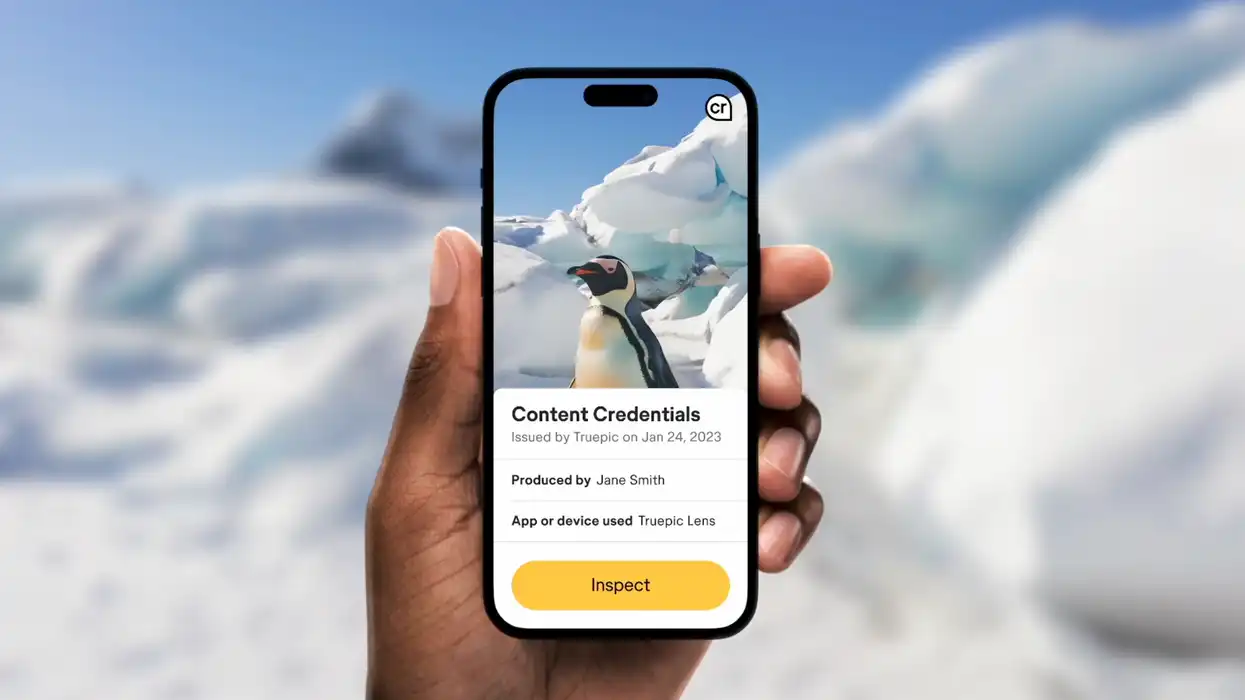
The obvious question is whether Apple’s system and C2PA could be made to work together, since they are trying to establish the same thing. Technically, a path exists. C2PA already has provisions for referencing an original image: a manifest can carry a hash of the original, a small copy of it, or a pointer to one stored elsewhere. Apple’s credential and reference image could in principle be carried inside a C2PA manifest, with Apple listed as a trusted signer whose signatures other systems agree to honor. Nothing in the design forbids it.
But the two systems are built on different theories of proof, and this is where they diverge. C2PA documents history. It records what an image is and what was done to it: captured on this device, cropped here, color-adjusted there, exported by this software, a running account of the image’s life. Apple documents origin by preservation. It keeps a locked copy of the starting point and lets you compare, saying nothing about what was done in between, only whether the current version still matches the original. One tells you the story; the other hands you the first page and lets you check it against the last. Both are legitimate, and they answer different questions. An editor who wants to know whether a crop is honest is served by C2PA’s record; an editor who wants to know whether anything at all was changed is served by Apple’s comparison.
Because they answer different questions, bridging them would be additive rather than redundant, which is an argument for doing it. The obstacle is not technical but institutional, and Apple’s security document makes the divide explicit rather than hiding it. Apple argues directly that C2PA’s after-the-fact signing is vulnerable anywhere along the editing chain, and that requiring a photographer to vouch for an image with their own credential can endanger those working in hostile conditions. Its own system answers both points, signing at the sensor and signing anonymously through Apple rather than through the photographer. These are real advantages, and they are also the reasons Apple built apart: a system designed to need no external identity and no external trust list is a system designed not to interoperate. Apple is not a member of the C2PA coalition. Its one gesture outward, reading Google’s SynthID watermark, is the kind it controls. Making its own proof readable elsewhere is the step it has not taken.
A Scoped Verdict
It would be easy to treat Reference Image as another proprietary land grab dressed up as a public good. That would be wrong. What Apple has built is the most rigorous image-provenance system anyone has shipped: it signs at the sensor rather than after processing, closing the gap every C2PA camera leaves open; it bounds capture time with cryptographic proof instead of a device clock; it signs with a post-quantum scheme meant to hold for decades; and it does all this without forcing photographers to attach their identity to their work, a real protection for anyone shooting where being identified is dangerous. On the engineering side, no competitor is close.
The limits aren’t failures of execution but the cost of the choices that make the engineering possible: verification only on Apple devices, a reference image someone has to deliberately send, and capture only on the latest iPhones with the feature switched on. That these are choices, not necessities, Apple showed on the same phone. For the synthetic images its own tools generate, it adopted SynthID, an open watermark anyone can read. For the authentic images its camera captures, it built a closed system only its devices can verify. Apple chose to interoperate when labeling fakes, and not when certifying truth.
So both sides are true at once. For a professional inside Apple’s ecosystem, Reference Image is not just good; it is the best available. As a contribution to shared trust in images across the open internet, where they actually circulate, it is limited by design, because everything that makes it trustworthy makes it Apple’s alone. Whether it becomes more than an Apple feature depends not on the technology, which is sound and in places remarkable, but on whether Apple chooses to let any of it work beyond its own devices.
Where This Goes Next
Two questions follow from all of this, and neither can be answered yet.
The first is whether Apple will license or open the technology: publish the format, extend the reader beyond its own operating systems, or bridge to C2PA. Everything about the system’s reach depends on this, and nothing Apple has said addresses it. The answer will determine whether Reference Image stays a feature of Apple’s products or becomes part of the infrastructure the whole industry relies on.
The second is how much Apple’s weight in photography makes that choice matter. The iPhone is among the most used cameras in the world, and a provenance system attached to it starts with a scale no camera maker and no standards body can match. If Apple opens it, that scale could pull the industry toward a common practice. If Apple keeps it closed, the same scale entrenches a large island of proof that the rest of the ecosystem cannot read. The size of Apple’s position is what turns a product decision into a question about the future of the whole field.

Author: Paul Melcher
Paul Melcher is a highly influential and visionary leader in visual tech, with 20+ years of experience in licensing, tech innovation, and entrepreneurship. He is the Managing Director of MelcherSystem and has held executive roles at Corbis, Gamma Press, Stipple, and more. Melcher received a Digital Media Licensing Association Award and has been named among the “100 most influential individuals in American photography”
Comments are closed, but trackbacks and pingbacks are open.