
At the Media Provenance Summit in Bergen on September 22, a lot was said and shown about producing transparent and indelible provenance information. Little, if anything, was said about how the general public would receive and understand that information.
Neeltje Berger and Viktor Kewenig of Microsoft Research presented “Design Led Research for Provenance UX.” One slide asked the question everyone building provenance should be asking: what did people base their trust on?
Microsoft is not alone in asking. Since 2020, researchers at the University of Washington, MIT, the University of Bergen, the University of Zurich, and elsewhere have put provenance labels in front of tens of thousands of people and measured what happened. Read together, their results converge on four findings, each with consequences for how publishers and platforms display provenance.
Trust lives behind the click
A word of caution first: no two of the studies below tested the same label, and the type of label changes the result.
The first finding is that provenance works for the people who look at it. The largest of these studies, Trattner, Forstner, and colleagues at the University of Bergen, published in 2026, showed 6,114 people news previews from the US, UK, and Norway, with or without a provenance label, at three levels of detail.
With the label, participants rated images as more transparent and more credible, and they trusted the news source more. The BBC’s own user research found no negative effect from showing provenance and a significant increase in trust among people who do not normally use the BBC. Among its regular readers, whose trust was already high, the effect was neutral.
The problem is getting them to click. In a second Bergen study, tested a C2PA label in a mock news app that suggests articles, with 202 participants. Between 2% and 6% clicked through to the explanation, depending on the label. Not much. 44% believed the label rated the article’s trustworthiness, when it only described the image. Those who saw the C2PA label also overestimated how well they understood it.

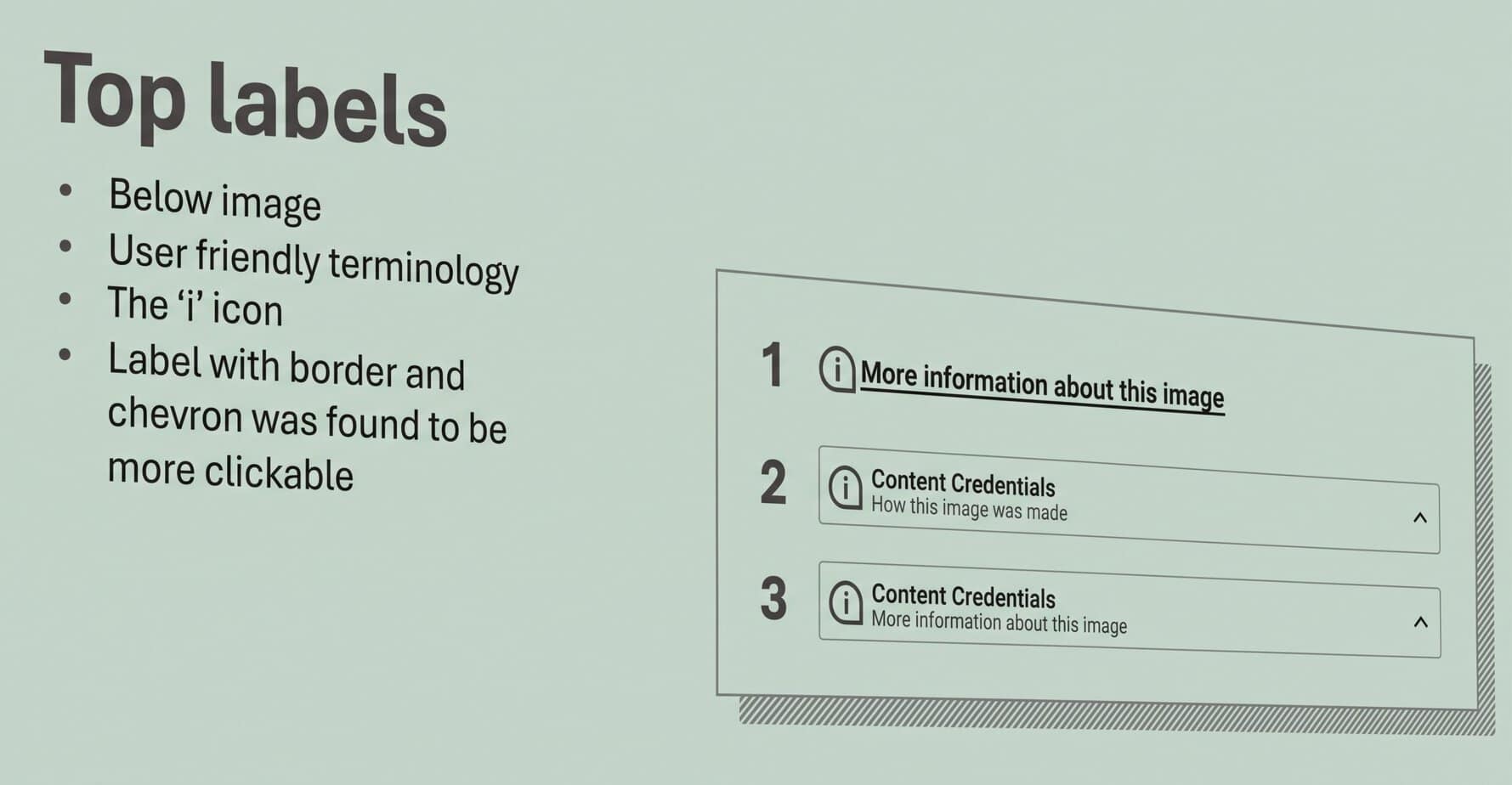
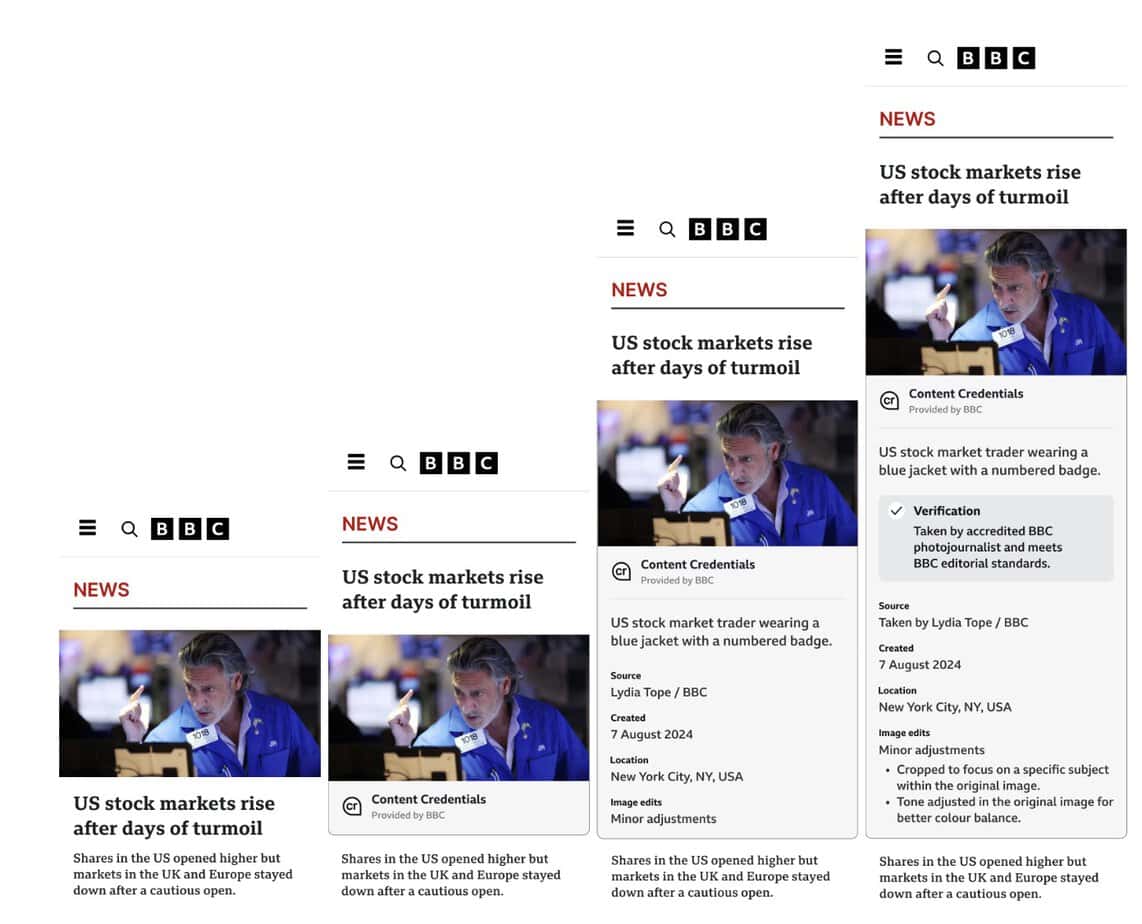
Microsoft tested which label designs people were most likely to click. The three it ranked highest all sat below the image and started with an “i” icon. The top one was a plain underlined link reading “More information about this image.” The other two were boxes titled “Content Credentials,” with a second line underneath (“How this image was made” or “More information about this image”) and a small arrow on the right. Microsoft found the boxed version, with its border and arrow, more clickable
The implied truth effect
The second finding concerns the images that carry no label at all. Microsoft asked whether it would matter to people if AI was used. About 80% said yes, whether the image was AI-generated, human-made or ambiguous. Then it asked what the absence of a label means. 18.2% read it as a sign the image is more trustworthy or authentic, 7.5% as proof no AI was used, and 5.9% as proof it was unedited. Among people who never clicked on a label, 30.4% assumed an unlabeled post involved no AI. Take that Article 50 !
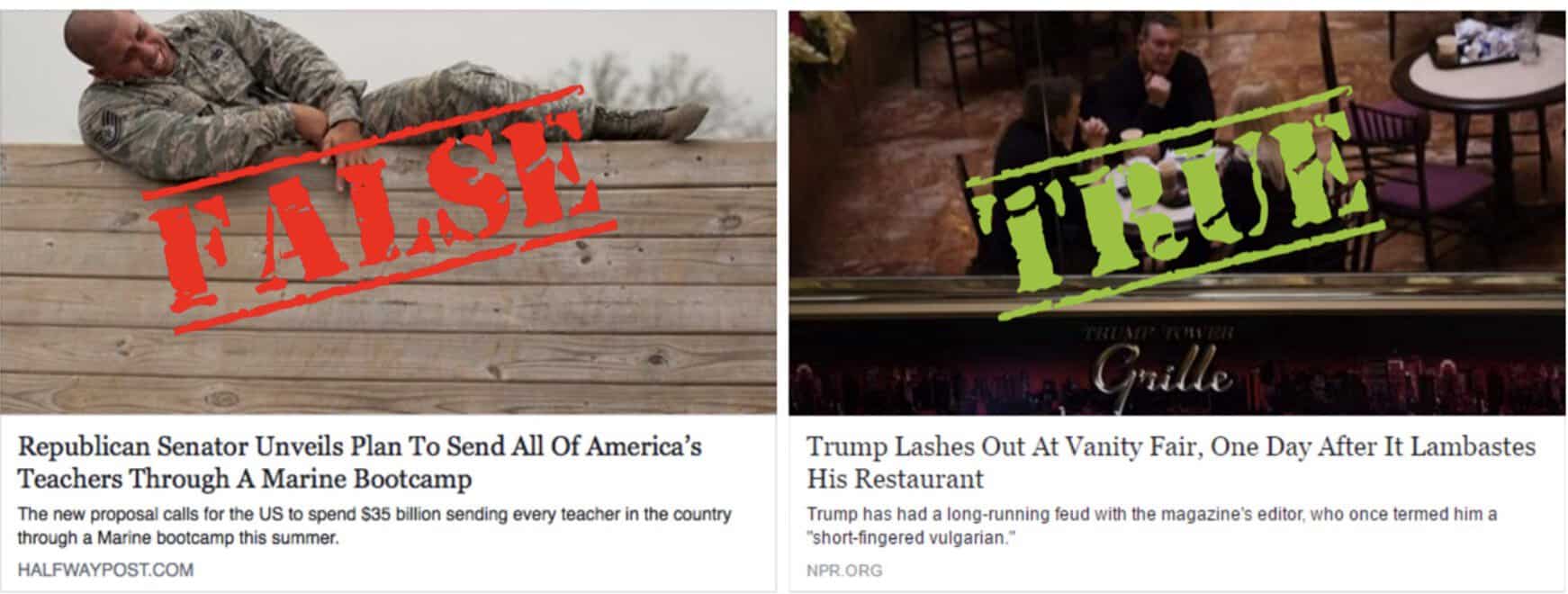
This is not new. In 2020, Pennycook, Bear, Collins and Rand showed news headlines to 5,271 people in a first experiment. Some of the false headlines carried a warning, others did not. People believed the flagged ones less. But once readers knew warnings existed, they assumed a headline without one had been checked, and believed false headlines that had slipped through more than readers who had seen no warnings at all. The researchers called this the implied truth effect. The fix was to mark some true headlines as verified too. The effect then disappeared.
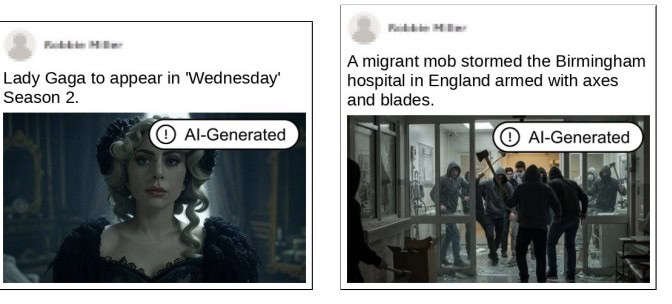
The same thing happens with images. In 2026, Höltervennhoff and colleagues showed 1,354 people in the EU and the US social media posts, each making a claim and illustrated with a picture. Some pictures were AI-generated and marked “AI-Generated.” Others were real photos, with no label. When a false claim came with a labeled AI image, people believed it less. But they became more likely to believe a false claim when it came with a real, unlabeled photo. The researchers call this overreliance on the label.
The mechanism is simple. Once readers learn that AI images get a label, every image without one becomes presumed real. On today’s platforms, that presumption is a gift to whoever does not label. An audit of four platforms under EU law found that only 33% of expert-identified deepfakes on topics the EU treats as risks to society carried a platform AI label, while reaching a median of 160,000 views. The other two-thirds carried no platform label, exactly where the studies above say readers lean toward believing them.
Microsoft’s conclusion from its own data is blunt: labeling only assets that include AI will lead to unlabeled assets being misinterpreted. People want to know the role of AI, and that includes knowing when AI was not used.
Words that say more than intended
The third finding is that the label wording carries meanings its authors never intended. Microsoft asked participants which wording was clearest or most useful. Four neutral terms about origin took the top places: “More information” (18.2%), “Image Source” (17.9%), “How this was made” (13.6%) and “Image Origin” (12.5%). Together, 62.2%. Every term built around AI scored under 6%, from “Made with AI” and “AI-generated” (5.7% each) down to “AI Modified” (1.1%). “Content Credentials,” the name the C2PA ecosystem adopted for its label, was picked by a paltry 5.4%.
The reason AI wording performs so poorly is now well documented. Altay and Gilardi ran two experiments with 4,976 people in the US and UK. Headlines labeled “AI-generated” were believed and shared less, whether they were true or false, and whether they were written by a human or by AI. The effect was three times smaller than labeling a headline “false,” but it hit true and false alike. When the researchers asked why, participants explained they assumed a headline labeled “AI-generated” meant AI had done everything, from choosing the topic to writing the story, with no human supervision. Gilardi pIointed out that this kind of full automation is unusual in journalism.
Words also change meaning across languages. Working with Ziv Epstein, Cathy Fang and Antonio Arechar, David Rand’s team tested nine terms on more than 5,100 people in the US, Mexico, Brazil, India and China. “AI generated” and “AI manipulated” were understood as made with AI. “Deepfake” and “manipulated” were understood as misleading, whether AI was involved or not. Chinese speakers associated “artificial” with human involvement, the opposite of what it suggests in English, Portuguese and Spanish. “Artificial” in Chinese is 人工 (rengong), made of 人 (person) and 工 (work). It reads closer to “human-made” or “manual labor,” so even the Chinese word for AI translates most faithfully as “human-made intelligence.”
Meta learned this in public. Its “Made with AI” label, launched in May 2024, landed on real photographs touched up with basic editing tools, and photographers complained. On July 1, 2024, Meta renamed it “AI info.” In Microsoft test, when asked which wording was the clearest, only 3.2% picked “AI Info.”
A 2026 review of 47 studies found the same. Licenji and Hoxha looked at research on AI in news. Skepticism appeared most likely when a disclosure implied full automation without saying who was accountable or whether a human had reviewed the work.
When the label works backward
The fourth finding is the most uncomfortable. A label read in passing works as a shortcut, and shortcuts misfire in both directions.
The starkest case comes from China. Lin and Zhang, publishing in the Journal of Science Communication in March 2026, showed 433 people science posts styled for Sina Weibo, some accurate, some not, randomly tagged as AI-generated. The label lowered the credibility of the accurate posts and raised the credibility of the false ones. The authors call it a heuristic trust trap: the label signals that a machine produced the content, readers associate machines with objectivity, and they skip the checking the label was meant to trigger. The authors offer this as an explanation; they did not test it.
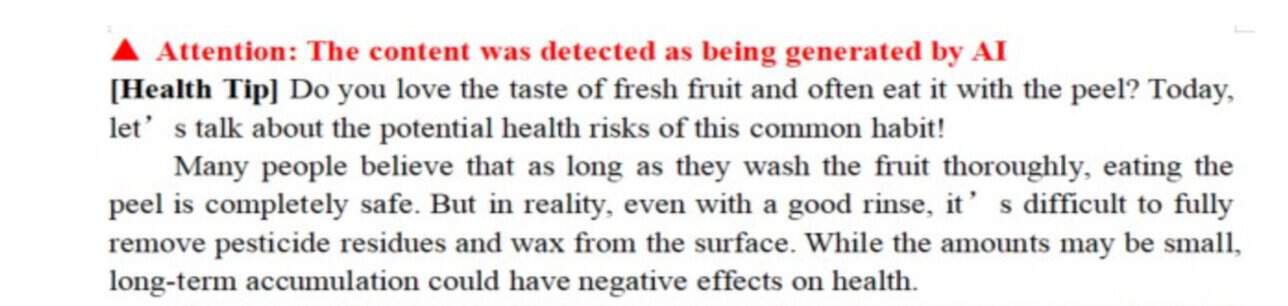
Western studies show milder versions of the same reversal. Höltervennhoff’s participants became more hesitant to believe true claims illustrated with labeled AI images. Altay and Gilardi’s “AI-generated” label pulled down true headlines along with false ones. In the Bergen news app study, an image label raised trust in the whole article, even though it said nothing about the article.
Provenance has its own version of the problem. Feng and colleagues at the University of Washington, working with the BBC and Adobe, put a C2PA-style label on images in a mock social feed for 595 people in the US and UK. Clicking it opened a panel showing the image’s history. When the panel revealed that an image had been assembled from several images, trust and perceived accuracy dropped, as intended.
But when the panel showed the record of who made and edited the image as incomplete or invalid, participants sometimes disbelieved honest images. They confused the credibility of the provenance record with the credibility of the picture. An incomplete state, which in the study meant the image had been edited in a tool that did not update the record, was read as a verdict on the image itself.
What we still don’t know
For all the numbers above, the evidence base is thinner than it looks. Licenji and Hoxha’s review is the clearest measure. Of its 47 studies, only 10 tested a disclosure label at all, and only one isolated the label from everything else. Most tested text news. Most recruited participants through online survey services and showed participants a single article. Few tested whether results change by country, though the Chinese and MIT results above suggest they do.
The image studies share the same habits. Most are short online experiments on mock feeds, and most of their participants were recruited in the US and UK. The Bergen news app study ran on desktop computers, while most of its participants said they read news on their phones. The BBC has tested provenance labels outside a lab, on live BBC Verify articles.
Some results also pull against each other. Feng’s team found no significant difference in trust whichever name the label carried, “Content Credentials,” “Content History” or two others. Microsoft found large differences in which wording people found clearest. Both can be true, since one measured trust and the other preference, but none of these studies tested whether the clearer wording gets more clicks on a real site.
And the largest study still needs checking. As of August 2026, a call for an independent replication of the 6,114-person Bergen study said it could not find the study’s analysis code or participant data publicly.
So what should publishers and platforms do?
The evidence is incomplete, but it is consistent enough to act on. Taken together, the studies point to six practical rules.
- Design the label to be opened. Place it below the image, use the “i” icon, give it a border and a small arrow, and write it in plain words such as “More information about this image” or “How this was made.”
- Put the work into the panel. That is where trust is formed. Say who made the image, who stands behind it, and what was done to it, in language a reader understands on first reading.
- Label authentic images too. A signed photograph from a newsroom or a camera deserves its own visible credential. Leaving it unlabeled hands its credibility to every unlabeled fake next to it.
- Describe the role of AI, and the human role with it. A bare “AI-generated” tells readers no human was involved. Say what the AI did and who reviewed the result.
- Explain broken chains as missing information. An incomplete or invalid record should say what is missing and why, so readers do not read it as proof the picture is fake.
- Test the words in every language you publish in. What works in English may mean something else in Mandarin.
The signing works. Cameras sign, newsrooms sign, and the standard keeps maturing. User studies show the outcome now depends on one small gesture: whether the reader clicks the label. In the one study that reported click rates, between 2% and 6% did. That is the number the industry needs to move.

Author: Paul Melcher
Paul Melcher is a highly influential and visionary leader in visual tech, with 20+ years of experience in licensing, tech innovation, and entrepreneurship. He is the Managing Director of MelcherSystem and has held executive roles at Corbis, Gamma Press, Stipple, and more. Melcher received a Digital Media Licensing Association Award and has been named among the “100 most influential individuals in American photography”
Comments are closed, but trackbacks and pingbacks are open.