
There is an assumption running through every conversation about AI and creative work. It goes like this: creativity is about the idea. The vision, the concept, the spark. Everything that follows, the execution, the craft, the labor of making, is downstream. Important, maybe, but secondary. The genius is in knowing what to build.
AI has supercharged this assumption. In the world of generative tools, the creative act has been compressed into the prompt. You describe what you want, the machine produces it, and the space between intention and result, the hours in the darkroom, the hand on the brush, the years learning to see light, collapses. Building is no longer the hard part, we’re told. Knowing what to build is where things get real.
But what if this fundamentally misunderstands creativity? What if the assumption that creativity lives in the idea, and only in the idea, is not just incomplete, but a misunderstanding of what creativity actually is?
Before anyone can credibly claim that AI replaces, threatens, or enhances creativity, we should probably agree on what creativity means. And when you look at what philosophy, neuroscience, sociology, and biology have actually found, the picture that emerges is quite different from the one the AI conversation assumes.
The spark and the space
Philosophers have debated creativity for centuries, and they broadly agree on one thing: a creative product must be both novel and valuable. Originality alone doesn’t count: a random string of letters is new but worthless. This is called the standard definition, and it focuses on the output. But almost every serious philosopher who starts with the product ends up talking about the process that generated it. The output, it turns out, can’t be separated from how it was made.
Margaret Boden, one of the most influential thinkers in this space, identifies three types of creativity. The first is combinatorial: familiar ideas recombined in unfamiliar ways. A collage. An analogy. A metaphor that connects two things that nobody connected before. The second is exploratory: working within an established style, tradition, or set of rules and pushing it to uncover possibilities nobody noticed. The third, and deepest, is transformational, actually altering the rules of the space itself, making thinkable what was previously inconceivable.
Here’s what matters for our purposes: two of these three types require constraints. They require a structured space, a tradition, a medium, a set of rules, within which to work. The choice of brush, the type of paint, the dimensions of the canvas, and the focal length of the lens: these define the conceptual space. They’re where creative thinking happens, not what precedes it.
Thinking in the medium
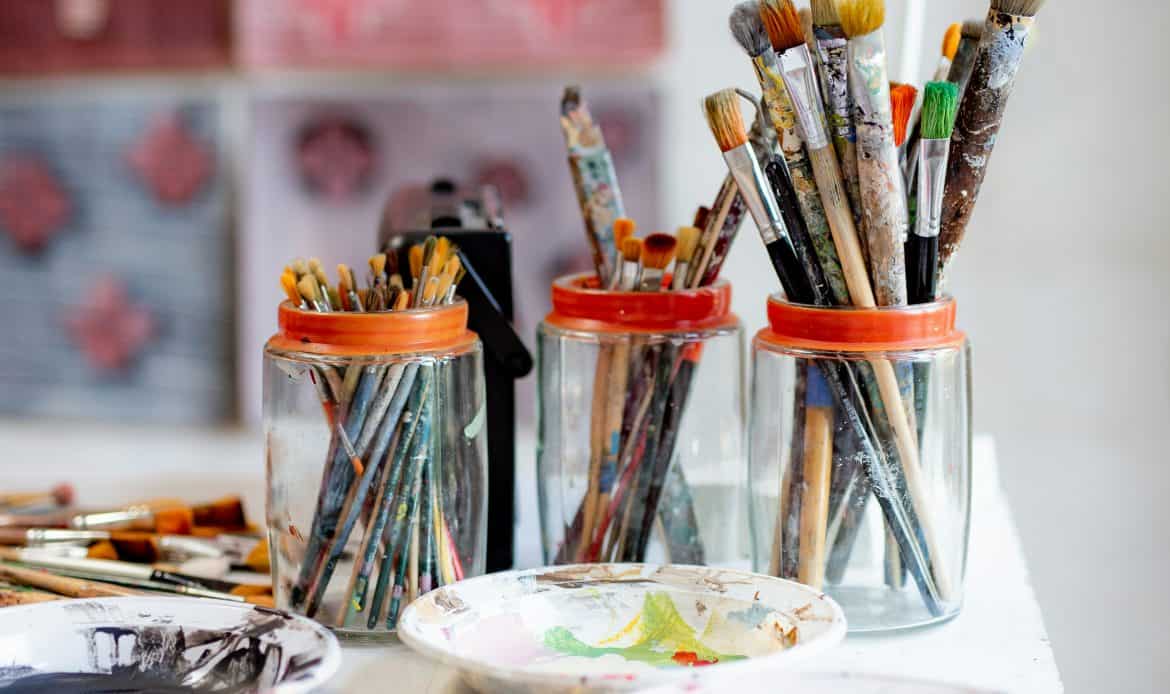
This insight was articulated most powerfully by the philosopher John Dewey almost a century ago. In Art as Experience, Dewey argued that the artist doesn’t have an idea and then execute it. The artist thinks in the material. The painter’s intelligence is in the response to each brush stroke. The musician’s creativity is in the fingers on the strings, the breath in the reed, the way the instrument pushes back and the player adjusts. The medium isn’t a vehicle for a pre-existing idea, it’s where the idea takes shape, gets tested, gets changed.
Neuroscience has caught up with Dewey. Brain imaging studies show that creative thinking activates a dialogue between two major neural networks. The default mode network, the same system active during daydreaming and mind-wandering, fires first, generating spontaneous associations. Then the executive control network evaluates, selects, and refines. Creativity isn’t a single flash. It’s an oscillation between generation and judgment, between wandering and focusing, and it happens continuously throughout the making process. Recent research has even shown that when you dampen the activity of the default mode network, people’s creative output measurably declines.
What neuroscience has also established is that creativity and intelligence are organized differently in the brain. Intelligent brains are optimized, fast, efficient, and well-connected along established pathways. Creative brains are messier. They bypass the usual hubs and make distant, unexpected connections between regions that don’t normally talk to each other. Creativity, at the neural level, isn’t about processing power. It’s about unusual pathways.
The conversation with resistance
Now consider what happens during the act of making. A growing body of research in embodied cognition argues that creativity doesn’t happen in the head and then get transferred to the world. It happens through the encounter between the maker and the material.
A ceramicist working with clay is in a dialogue. The clay has affordances, the things it allows, and constraints , the things it resists. The maker’s hands respond to the material’s behavior, and that response generates decisions that couldn’t have existed as abstract ideas beforehand. The same is true for a photographer composing a shot: the lens affords certain perspectives, the light constrains others, the subject moves, and the creative act happens in real time, in the negotiation between intention and circumstance.
Donald Schön called this “reflective practice” , the idea that professionals think in action, by conversing with the materials of a situation. This isn’t a metaphor. Studies of craft practitioners, architects, and designers consistently show that the physical encounter with materials generates knowledge and creative decisions that can’t be replicated through planning alone. The resistance of the medium — what it won’t let you do easily — is generative. It forces discovery.
Creativity doesn’t end with the maker
If creativity were only about the idea and its execution, we could stop here. But sociology has added a dimension that complicates things further. Mihaly Csikszentmihalyi, better known for his concept of “flow”, argued that creativity is a systems phenomenon. It requires three things: a person who brings novelty, a domain of accumulated knowledge and practice, and a field of people who evaluate and validate the work. Without the field, the audience, the critics, the community of practice, novelty never becomes creativity. It’s just difference.
This means creativity is never entirely inside one person’s head. The domain, the tradition of photography, the history of painting, and the conventions of visual storytelling provide the conceptual space within which the maker works. The field determines whether what emerged from that work changes the domain. Creativity is a circuit, not a moment.
More recently, Vlad Glăveanu has extended this systems thinking into what he calls the Five A’s framework: actors, actions, artifacts, audiences, and affordances. Each element is distributed across people, tools, and environments, reinforcing the idea that creativity can’t be reduced to what happens inside a single mind.
The chain that makes creativity
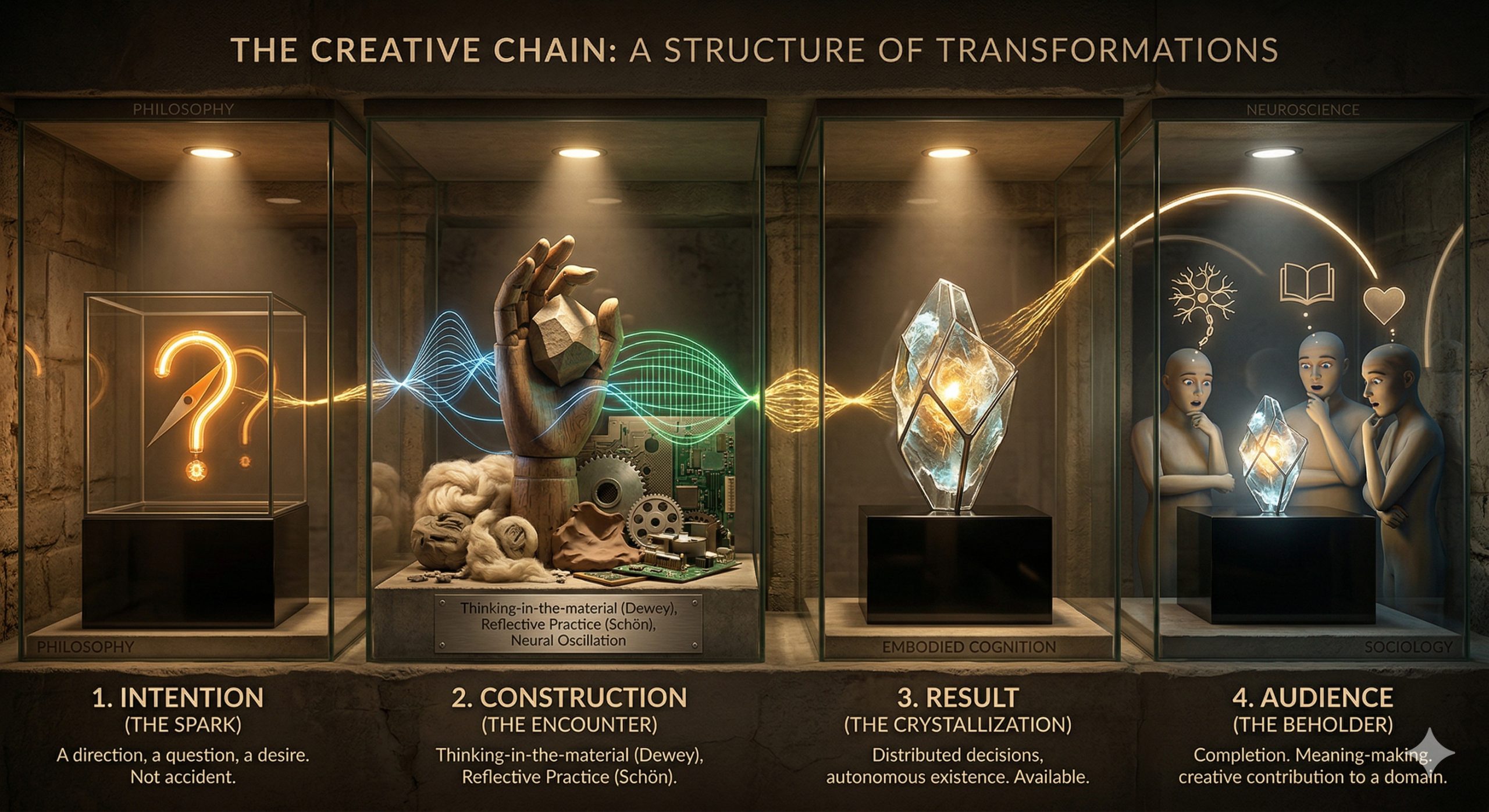
What emerges from all of this, philosophy, neuroscience, embodied cognition, sociology, is not a single definition but a structure. Creativity operates as a chain of transformations, where each stage alters what the previous one produced.
It begins with intention: a direction, a question, a desire to make something. Without intention, there is accident, but not creativity.
Then comes construction: the encounter with a medium, a set of tools, a set of constraints. This is where the idea meets resistance, physical, material, technical, and gets transformed by it. The maker discovers things that weren’t in the original intention. The medium talks back. This is Dewey’s thinking-in-the-material, Schön’s reflective practice, the neural oscillation between the default mode network and executive control.
The construction produces a result: an image, a painting, a composition, a text. The result crystallizes all the distributed decisions of the process into something that exists independently of its maker. It becomes autonomous, available for others to encounter.
And finally, the audience completes the circuit. The audience interprets, evaluates, and assigns meaning. Beauty is in the eye of the beholder. Without this stage, the result is an artifact, but not yet a creative contribution to a domain.
Each link transforms what came before it. The construction changes the idea. The result contains things the maker didn’t fully plan. The audience reads things the maker didn’t fully intend. Creativity is the whole chain.
Where does AI sit?
Map this chain onto the current reality of generative AI, and something becomes clear.
AI doesn’t originate intention. The human writes the prompt, chooses the direction, and asks the question. AI does produce results, often impressive ones. And audiences do encounter and evaluate those results.
But what about the construction stage, the encounter with resistance, the dialogue with the medium, the discovery through making? This is where things get interesting. AI does carry embedded rules: its training data functions as a kind of conceptual space, with aesthetic defaults, compositional biases, and stylistic tendencies. When a tool misinterprets a prompt, when it produces something unexpected ( six fingers ?), when it defaults to a style that the user must work with or against, that’s a form of friction. A different kind than the resistance of clay or the behavior of light, but friction nonetheless.
So AI doesn’t eliminate the construction phase. It changes the nature of the friction within it. Physical tools produce resistance through material encounter, the weight of the camera, the grain of the film, and the chemistry of the darkroom. AI produces friction through interpretive gaps, the distance between what you asked for and what you got back, the biases embedded in its training, and the limits of its understanding.
Both can generate surprise. Both can lead to discovery. But they engage different faculties. One is embodied, sensory, and responsive to the physical world. The other is linguistic, iterative, and abstract. They are different kinds of creative conversation.
The question worth asking
The conversation about AI and creativity has been stuck on the wrong question. “Is AI creative?” assumes creativity is a property that something either has or doesn’t have. The research across every discipline suggests otherwise. Creativity is a process distributed across intention, construction, result, and audience, a chain reaction where each stage transforms the last.
The better question is: what happens to the chain when the nature of one link changes? When does the friction of construction shift from material resistance to interpretive gap? When the maker’s body is no longer in the loop?
We don’t have definitive answers yet. AI is becoming more capable, and the nature of the friction it produces will evolve. Whether it will ever develop something like intention or participate in something like embodied discovery depends on what you believe creativity ultimately requires.
But we can’t have that conversation honestly without first understanding what human creativity actually is. And the evidence, drawn from a century of research across multiple disciplines, suggests that creativity was never just the spark. It was always the whole fire, the tinder, the oxygen, and the sustained, unpredictable burning that follows.
