
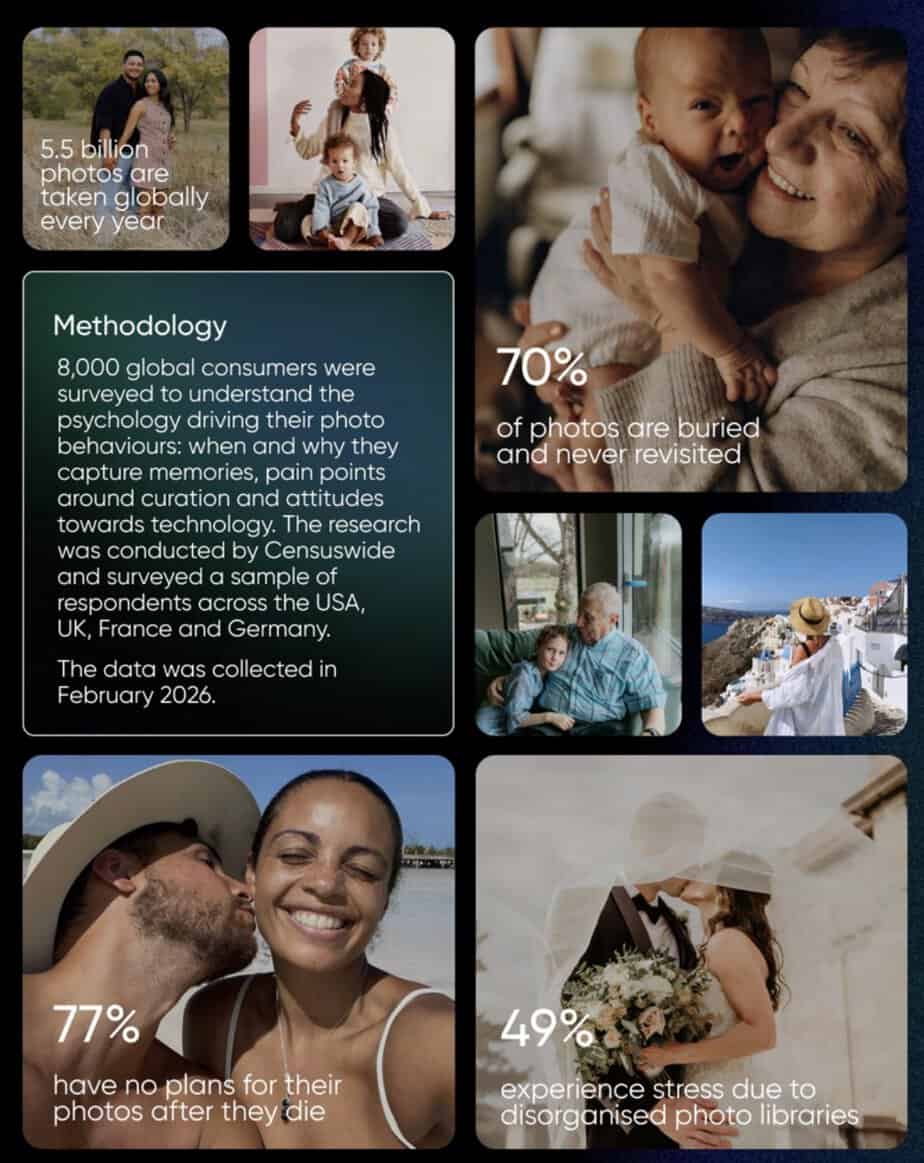
A recent study from Popsa highlights some very interesting facts about our relationship with photographs today. After surveying 8,000 non-professional consumers across different age groups and countries, the study reveals that 70% of the photos we take are never revisited. Of the roughly two trillion photographs taken each year globally, the vast majority are never seen again. Captured and forgotten.
And all this time, the camera was thought of as the memory machine. Maybe not.
The first and most obvious reason is volume. We bury ourselves in our own content. Younger generations take an average of 1,468 photographs per year, nearly three times more than the 491 taken by those over 55. At that scale, even the most disciplined person loses track.
But volume is the cover story. Underneath is something more interesting.
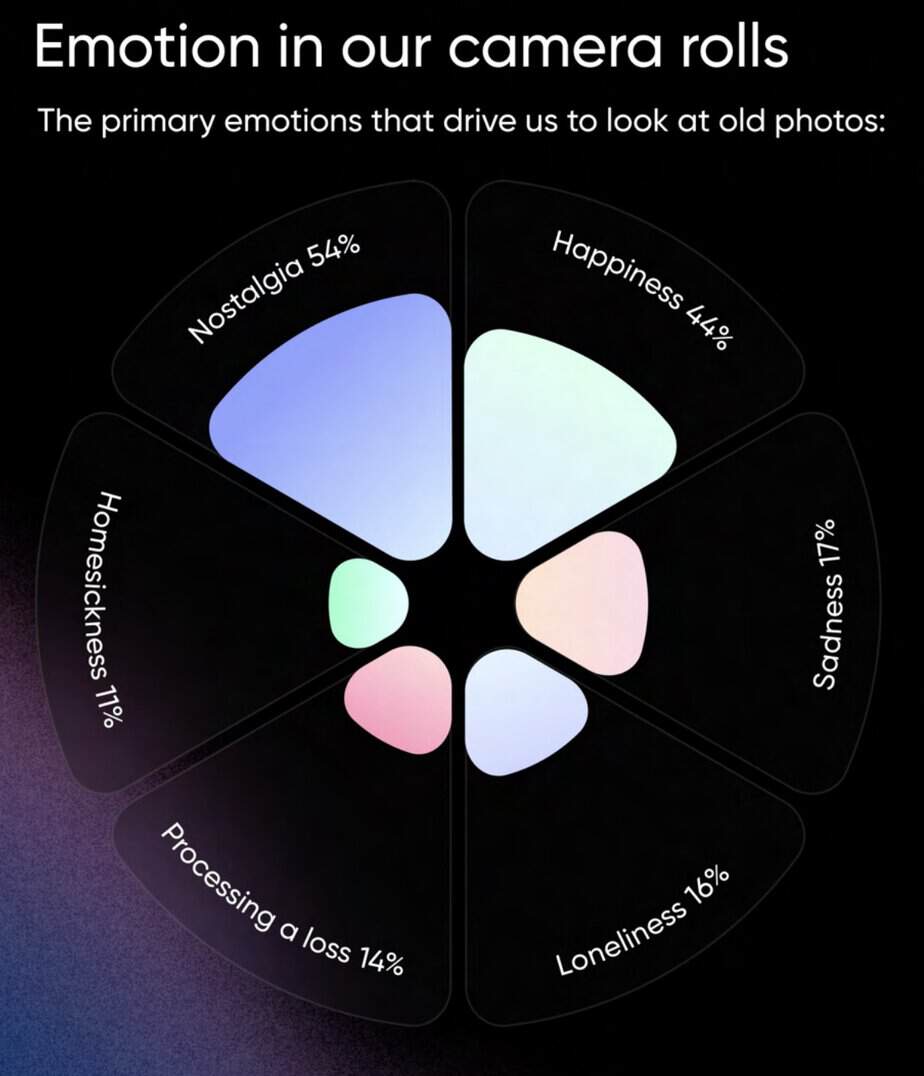
Nostalgia is the primary emotion people report when looking at older images, followed by happiness. After that come sadness, loneliness, loss, and homesickness. We don’t seek those feelings out, so we don’t go looking.
An emotional journey
We don’t capture images in a void. No image we take to remember is neutral. Every photograph carries a reason, and with it an emotion. The reason is fixed; the emotion is not. Over time, the associated feeling drifts. Because the person in the frame is no longer part of our lives. Because the event, when measured against where we are today, makes us feel bad about where we are.
Each image carries an evolving emotion. The context of viewing, our life context, changes what we feel when we see it again.
In the same study, among 18–24-year-olds, nearly three-quarters (73%) say they actively avoid certain photos, compared with only 29% of over-55s. The point worth pausing on: in order to avoid an image, you have to know it exists and what it contains. The photos we avoid are therefore closer to memory than the ones we never think about, because we don’t even know those are there.
Avoidance is a sign of existence. The real forgotten photos are the ones we don’t remember ever taking, the ones that no longer exist.
Which leaves a hard question the report dances around without naming: how do we curate for emotion, and harder still, how do we do it when that emotion evolves?
Curating the charge
Every photo-management tool ever built curates content by faces, places, dates, and aesthetic quality. The actual variable is the emotional charge, and the charge is non-stationary. The tools work with anchors, not variables.
Static curation assumes meaning is fixed at capture. If emotion drifts, then an archive curated once is already wrong by the time you open it. The real task is continuous re-evaluation, and no one wants to do that work; re-evaluating twenty thousand images is exactly the burden the archive was supposed to relieve us of. The tools promise to remove the labor of memory. The labor of memory is the only thing keeping the archive alive.
AI is structurally wrong for this. Face recognition, smart albums, “On This Day” resurfacings all assume that frequency, recency, and aesthetic quality approximate emotional importance. They don’t. The photo of the ex-spouse at the wedding scores high on every signal and is exactly the image you cannot bear to see. The blurry shot of your mother’s hands a year before she died scores low and is the only one that matters. The machine reads the file. The person reads the life.
Maybe the avoided photos are the signal nobody is capturing properly. Every photo app tracks what you tap, share, favorite. None track what you scroll past faster, what you swipe away from, what makes you close the app. We record the likes; we ignore the dislikes. The negative gesture sometimes carries more information about emotional charge than the positive one. A system that learned from avoidance could build a real emotional map of an archive. It would have to be honest about being a map of pain as much as joy, and no consumer product wants to be that.
The historical answer was forgetting by design. Pre-digital archives forgot for us. Prints faded, albums got lost in moves, negatives went to the bin. Physical attrition roughly matched emotional attrition. The shoebox in the closet was a curation system — gravity and dust did the work. Digital removed the attrition without replacing the function. We keep everything and curate nothing, so the drift accumulates with no release.
One tempting answer is programmed forgetting. A system that hides, or quietly archives beyond reach, photos you haven’t engaged with in N years, on the theory that emotional silence is real information. The trouble is the photo you forgot you had. The cousin at a wedding, the café in Lisbon, the friend’s child at three. Surface them again, and they light up. The rediscovery is itself the emotion. Silence might just mean we don’t know what’s in the file. So that is not an option.
Another tempting answer is to map the archive to the life itself, connect it to our social media feeds, learn our emotional states from our interactions, follow family, careers, health. Almost perfect for curating images by emotion. The privacy concerns are obvious. The deeper problem is that social feeds don’t read lives either. They read performances. A system built on that signal would curate the performance, not the memory.
So the answer is re-encounter. Systems that resurface randomly, ask, and let the person decide in the moment, looking at what the image is worth now. Instead of a like button, something more sophisticated with varying degrees of emotional response, because none of us are binary. An image of an ex-spouse that elicited a negative reaction would trigger the suspension of all images associated with that subject, at least for a while. Periodically, one or two would surface again as an emotional check-in to see whether they remain buried or begin a new life in the visible realm.
The honest version of the answer is that we cannot curate for an evolving emotion. We can only build systems that let the evolution happen, surfaces that change each year, archives that ask rather than assume, libraries you converse with rather than organize once.
The current tools are filing cabinets pretending to be memory. Memory is a process, not a folder.
Source: Popsa, The Memory Economy: 2026 Global Trend Report. Survey of 8,000 consumers in the US, UK, France and Germany conducted by Censuswide, February 2026.

Author: Paul Melcher
Paul Melcher is a highly influential and visionary leader in visual tech, with 20+ years of experience in licensing, tech innovation, and entrepreneurship. He is the Managing Director of MelcherSystem and has held executive roles at Corbis, Gamma Press, Stipple, and more. Melcher received a Digital Media Licensing Association Award and has been named among the “100 most influential individuals in American photography”
Comments are closed, but trackbacks and pingbacks are open.