
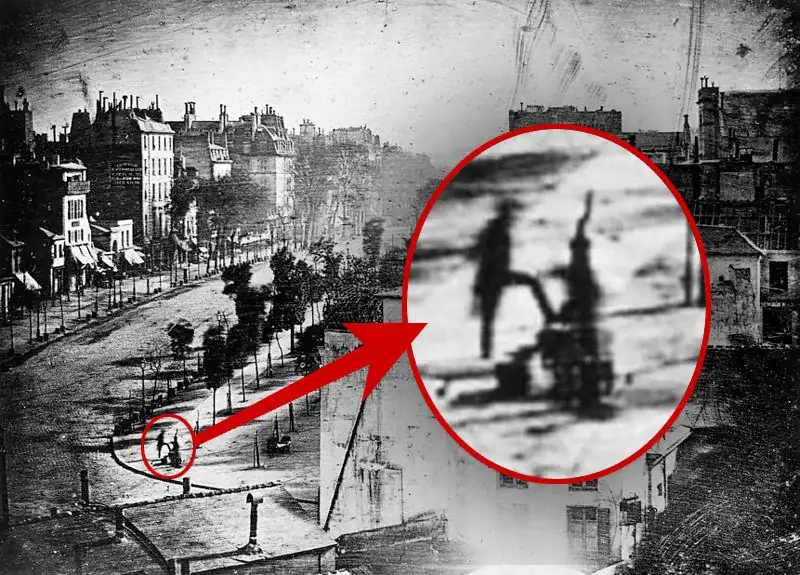
In the spring of 1838, Louis Daguerre pointed his camera at a Paris street. He was not looking for a person. He was trying to capture a city. One of the first photograph ever taken and the first one with people in it.
Look at the two figures. One is apparently working; the other is waiting. The street around them is almost empty, although we know it was busy.
Their stillness has made them visible. Everyone else has vanished.
There is a peculiar inversion here. Daguerre wanted to make a record of the city. Instead, history remembers two anonymous people whose presence was incidental to his purpose.
They did not choose to become historical figures. They did not pose for posterity, as far as we know. They were simply going about their lives, unaware that the new technology would preserve their outlines for nearly two centuries.
That leads to one question that has been haunting photography ever since:
Is a photograph a record of reality or a record of what the process allowed us to see?
The Boulevard du Temple is often described as a photograph of an empty street with two people in it. But that description is misleading. The street was not empty. The photographic process made it appear empty.
The image records a combination of the world and the conditions under which the world was recorded. Exposure time selected what became visible. The stationary architecture remained; moving bodies disappeared. The photograph did not lie, but neither did it provide a complete account of the scene.
This is an important distinction for visual authenticity. A photograph can be authentic as a photographic object and still give an incomplete or misleading impression of an event.
We often ask whether an image is real or fake. The historical photograph suggests a more productive question: What, exactly, is this image evidence of?
It is evidence that light from a particular scene registered on a photosensitive surface. It is evidence of certain visible forms. It is not proof that the scene was empty, that the photographer intended to document the two people, or that our interpretation of those figures is correct.
Authenticity does not eliminate interpretation.

Author: Paul Melcher
Paul Melcher is a highly influential and visionary leader in visual tech, with 20+ years of experience in licensing, tech innovation, and entrepreneurship. He is the Managing Director of MelcherSystem and has held executive roles at Corbis, Gamma Press, Stipple, and more. Melcher received a Digital Media Licensing Association Award and has been named among the “100 most influential individuals in American photography”
Comments are closed, but trackbacks and pingbacks are open.