
Until now, you have been the author of your own life. Not in the romantic sense — you don’t control everything that happens to you. But you controlled the telling. What you revealed and to whom. What you let recede into memory and what you chose to carry forward. The narrative of your existence — its arc, its texture, its silences — was yours to shape. That is ending. Not gradually, not metaphorically, not in the abstract way that privacy advocates have been warning about for decades. Concretely, technically, irreversibly. The architecture that will take that authorship from you is already built. Most of it is already running. The last elements are about to be turned on.
The Architecture of Total Capture
It begins in orbit. Planet Labs photographs the entire landmass of Earth every day; Vantor resolves to 30 centimeters, quite enough to identify individual vehicles. Below the satellites, more than 1,700 U.S. police departments operate drones, their feeds routed into Real-Time Crime Centers that now run in over 130 cities, aggregating live footage from traffic cameras, license plate readers, and body cams into a single AI-assisted view. The sky is no longer empty. It is a continuous sensor array, from orbit to rooftop, with no gaps.
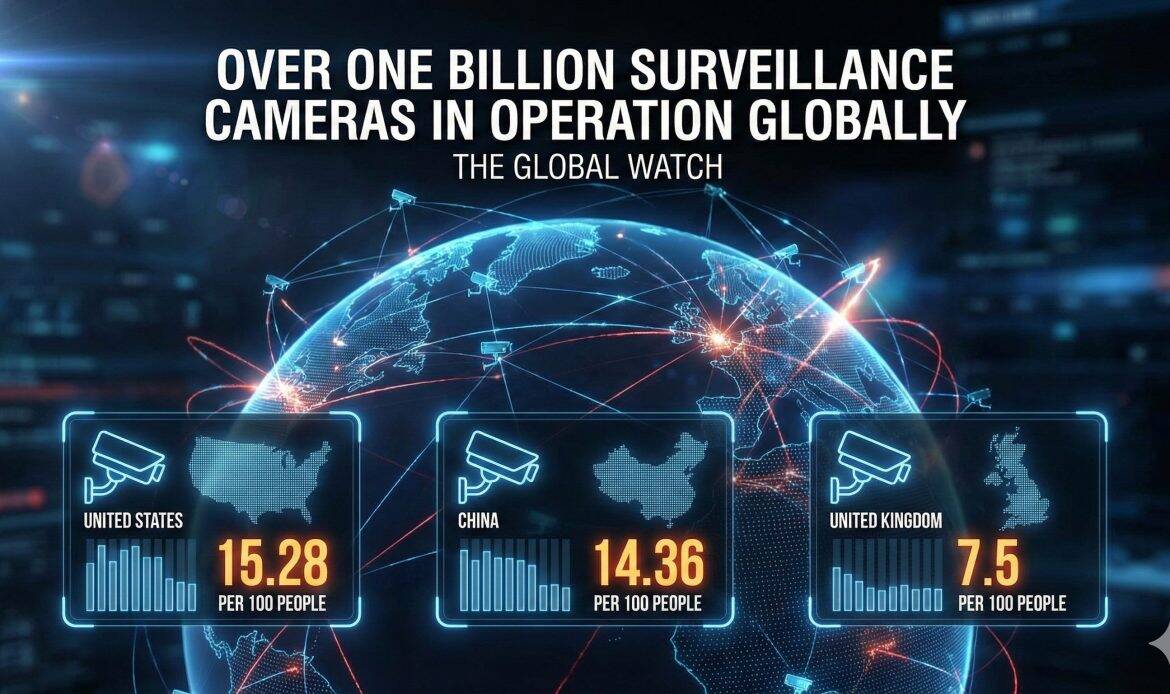
On the ground, over one billion surveillance cameras are in operation globally — 15.28 per 100 people in the United States, 14.36 in China, 7.5 in the UK. Those numbers exclude the cameras inside every bank, pharmacy, supermarket, hospital, school, restaurant, and parking garage. The average working American is captured on camera at least 238 times per week. A person moving through a city is handed off, frame by frame, along an unbroken chain.
Beyond government infrastructure, a parallel private network has grown larger and less visible. Flock Safety , a private company, not a government agency , operates 100,000 cameras across 49 U.S. states, scans 20 billion license plates every month, sells access to more than 5,000 police departments, and in late 2025 merged its network with Amazon Ring, extending its reach into tens of millions of private homes. No legislature voted for this network. It exists because the business model works.
Every vehicle adds more. Dashcams log every road and pedestrian. Rideshare cameras record the street outside and the passenger inside simultaneously. And in every pocket: 7 billion smartphones, each with a camera, each capable of posting to social media within seconds. There is almost no gathering of people anywhere in the world that is not also a gathering of cameras and a potential broadcast.
Cameras are already inside the home, too. Robot vacuum cleaners map floor plans and photograph rooms. Smart TVs watch you watch them. Baby monitors, smart refrigerators, and home security hubs have become, secondarily, surveillance devices, owned by the companies that made them, accessible in ways most buyers never read in the terms of service.
The last gap is the face-to-face, and it is closing. Meta Ray-Ban smart glasses sold 7 million units in 2025, recording video and streaming live, with voice interactions stored by default for up to a year. A $60 online modification disables the LED recording indicator while leaving the camera fully operational. In October 2024, two Harvard students demonstrated that off-the-shelf Meta glasses connected to free facial recognition software could identify strangers in real time: names, addresses, social profiles, from a single glance. Meta’s internal response, revealed in documents leaked to the New York Times in February 2026, was to develop “Name Tag,” a productized version of exactly that capability, timed to launch when civil society would be too distracted to resist.
Three days later, Bloomberg reported that Apple is simultaneously accelerating three camera-equipped AI wearables: smart glasses, a pendant worn on clothing, and AirPods with integrated cameras , all built around an always-on AI with continuous awareness of everything the wearer sees and hears. Consumer products. Lifestyle accessories. Identical in effect to surveillance.
Their effect on everyone within range of their wearer is identical to surveillance. And these are no longer only corporate products. Vision Claw, an open-source tool available on GitHub, already turns any smartphone camera into an always-on AI agent using Google’s Gemini Live, capable of seeing, hearing, and acting on its surroundings in real time, without any proprietary hardware at all.

The Loss of Control
The footage of your day — where you went, who you spoke to, how long you stayed — is being assembled right now by hundreds of actors you have no relationship with. None of them asked. None are obligated to tell you. None of that footage belongs to you. You don’t even know it exists.
What you own, by the same logic, is the equivalent record of everyone who crossed your path. You are simultaneously subject and holder, in a system no one designed or governs, yet which structures itself around you regardless. No single layer is totalizing on its own. But license plate readers, fixed cameras, mobile cameras, and wearables, cross-referenced by AI, produce the complete, continuous reconstruction of any person’s movements, associations, and behaviors, indefinitely into the past and the future. That is not surveillance in any sense the word has previously meant. It is a permanent record of human life, assembled by default, held by others, and almost entirely beyond the reach of the person it is about.
The Transformation of Time
Memory is partial, subjective, and mortal. Arguments about what happened have always contained room for interpretation. That condition is ending. The past is about to exist as a recording: fixed, indexed, multi-angle, permanent, yet stripped of context, of your intents, reasons, emotions.
Which brings another paradox: as recording becomes universal, trust in footage should increase. Instead, the opposite is happening. AI can now generate video indistinguishable from an authentic recording and manipulate real footage without a visible trace. The proliferation of cameras produces an equal number of equally suspect recordings, some real, some fabricated, with no mechanism to tell them apart. Not one camera in the architecture above carries any cryptographic record of its own authenticity. The only surveillance camera with built-in provenance infrastructure is Ring. Everything else enters the world unsigned and technically indistinguishable from fabrication. The C2PA standard — the most serious industry effort to attach verifiable provenance to digital media — lives in professional cameras and creative software. The surveillance stack has not adopted it. In the age of AI-generated imagery, a world blanketed in cameras without provenance does not produce certainty. It produces the perfect conditions for deniability.
No Proof, No Protection
Europe’s GDPR , the strongest data protection framework ever produced , offers no practical mechanism against the Ring camera across the street or the satellite image of your home taken this morning. Even the right to erasure stops at the threshold of physical space: it assumes an identifiable data controller, reachable, subject to European jurisdiction. And even within its own domain, the framework is retreating: the European Commission’s Digital Omnibus of November 2025 proposed rolling back key provisions of both the GDPR and the EU AI Act under commercial pressure, at precisely the moment the surveillance infrastructure is completing itself.
Outside Europe, meaningful protections are the exception. The United States has no federal privacy law. Most of the world has nothing comparable to GDPR. There is no legislation currently in force, anywhere, that addresses what this article describes. That is not an oversight waiting to be corrected. It is the environment in which total capture is being built, normalized, and made irreversible.
All of Your Life Belongs to Us
We are crossing into a world where everything leaves a trace. Where you go, when, with whom. How long you stayed. How you looked walking in. What you ordered. Who you left with. None of that record will belong to you. It will belong to the neighbor with a Ring camera, the private company that logged your license plate, the platform whose glasses were on the face of someone you trusted, the satellite that happened to pass overhead. Assembled by AI, cross-referenced across layers, it will paint a portrait of your life more complete and more permanent than anything you would have chosen to leave behind — more precise, more indelible, than your own memory or the memory of anyone who loved you.
And then there is the dimension that may feel most immediate. Any moment , a bad day at an airport, an argument at a restaurant, a stumble on the street, a private grief in a public space , can be on social media within minutes, stripped of all context, offered to an audience of millions who know nothing about you except what that frame shows. You become, without warning and without consent, a character in someone else’s content. Laughed at. Condemned. Defined by a single moment you didn’t know was being recorded, in a court of public opinion you never agreed to enter, with no right of reply that reaches as far as the original clip.
Every civilization before this one has had private life as its default condition, with surveillance as the exception — something that had to be deliberately arranged, resourced, and aimed. We are crossing into a civilization where that is reversed. Total capture is the default. Privacy is what must now be fought for. That crossing is happening now, without public deliberation, without legislation, without a word for what we are losing. The last elements are about to be turned on.
